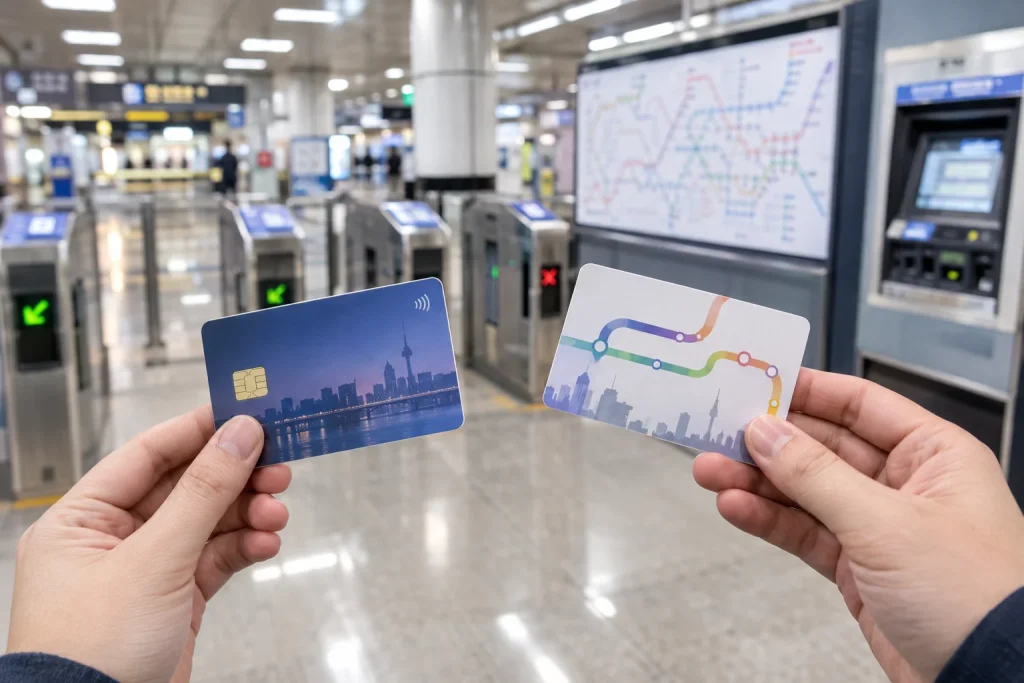
T-money vs Climate Card for Korea travel is an important choice for visitors who plan to use public transportation frequently in Seoul.
Both cards can make transportation easier, but they work in very different ways.
T-money is a rechargeable stored-value transportation card that deducts the fare each time you travel. The Climate Card Short-Term Pass is an unlimited-use pass for eligible Seoul public transportation during a fixed period of one to seven days.
T-money vs Climate Card for Korea travel: the quick answer
For most visitors, the decision comes down to where you are traveling and how often you expect to use public transportation.
- T-money: better suited to flexible travel across Seoul and other parts of Korea
- Climate Card Short-Term Pass: designed for frequent public transportation use mainly within Seoul
You do not necessarily need to use only one for your entire trip.
What is T-money?
T-money is a rechargeable prepaid transportation card.
You add money to the card and the appropriate fare is deducted each time you use eligible transportation.
T-money can be used on a wide range of transportation systems throughout South Korea.
Where can T-money be used?
According to VISITKOREA, T-money works across many forms of Korean public transportation, including:
- Subways
- City buses
- Express buses
- Intercity buses
- Some taxis
- Some rail and affiliated transportation services
It can also be accepted at selected convenience stores, vending machines, and other affiliated locations.
How T-money charges you
T-money does not provide unlimited travel.
Instead, each ride deducts the applicable fare from the stored balance.
Eligible transfers between buses and subways can receive integrated transfer discounts when you tap correctly when boarding and getting off.
What is the Climate Card Short-Term Pass?
The Climate Card Short-Term Pass is a Seoul transportation pass designed for unlimited use during a fixed number of days.
As of October 1, 2026, the previous 30-day Climate Card has been discontinued.
Short-term passes for visitors remain available.
Climate Card short-term prices in 2026
Current short-term pass prices are:
- 1 day — 5,000 won
- 2 days — 8,000 won
- 3 days — 10,000 won
- 5 days — 15,000 won
- 7 days — 20,000 won
The physical Climate Card itself costs an additional 3,000 won.
What changed on October 1, 2026?
This is important because older travel guides can now be outdated.
The 30-day prepaid and postpaid Climate Card products were discontinued at the end of September 2026.
Short-term passes remain available for travelers.
Seoul has introduced a separate Climate Pass system for eligible Seoul residents, but that is different from the short-term Climate Card used by tourists.
Where can you use the Climate Card?
The Climate Card Short-Term Pass is focused on Seoul transportation.
It covers eligible Seoul-based subway lines and Seoul-licensed city and town buses, including night buses.
However, not every rail line or bus outside Seoul is covered.
Important Climate Card exclusions
The Climate Card does not simply mean unlimited transportation everywhere around the capital region.
Current exclusions include services such as:
- Sinbundang Line
- GTX
- Intercity buses
- Airport buses
- Non-Seoul-licensed buses
- Some subway travel outside the eligible service area
Visitors should check the route before assuming a journey is covered.
T-money has a much wider geographic range
This is one of the biggest differences in the T-money vs Climate Card for Korea travel comparison.
T-money is not limited to Seoul.
If your itinerary includes places such as Busan, Daegu, Daejeon, or other Korean cities, a rechargeable transportation card is generally much more flexible.
The Climate Card is strongest for Seoul-heavy itineraries
The Climate Card Short-Term Pass becomes more useful when most of your transportation is inside Seoul and you expect to ride buses and subways frequently.
Because the pass allows unlimited eligible rides during its validity period, you do not have to think about the cost of every individual trip.
How the short-term Climate Card starts
Short-term passes begin when they are loaded or activated according to the current Climate Card rules.
A one-day pass is valid for that service day rather than for a rolling 24-hour period.
This matters if you buy the pass late in the day.
Can foreign credit cards buy a Climate Card?
Yes, this became easier in 2026.
Seoul introduced international credit and debit card acceptance at new transit-card vending machines for Climate Card short-term passes and single-journey tickets.
This means visitors no longer need to rely entirely on Korean cash or a domestically issued payment card at supported machines.
Buying and charging T-money is different
T-money is a stored-value card rather than an unlimited pass.
You buy the card and then add money as needed.
Reload methods depend on the location and machine, so keeping some Korean won available remains useful.
Which card is simpler for a first-time visitor?
T-money is usually easier to understand because the system is straightforward:
- Buy the card.
- Add money.
- Tap when boarding.
- Tap when leaving where required.
- Reload when the balance becomes low.
The Climate Card requires a little more planning because you need to choose the correct pass duration and stay within its eligible service area.
When the Climate Card can save money
A short-term Climate Card can be financially useful when you plan many eligible rides within Seoul during a short period.
For example, someone who repeatedly uses buses and subways throughout the day may benefit more from unlimited travel than from paying each fare separately.
The exact break-even point depends on your routes and how many rides you actually take.
When T-money is more practical
T-money is generally more practical when:
- Your itinerary includes cities outside Seoul
- You plan only a few transit rides per day
- You use airport or intercity transportation not covered by the Climate Card
- You want one card that remains useful throughout a longer Korea trip
- Your travel schedule changes frequently
Can you use both cards during one trip?
Yes.
A traveler could use a Climate Card Short-Term Pass during several intensive sightseeing days in Seoul and keep a T-money card for transportation outside the Climate Card service range.
There is no need to treat the decision as permanent for the entire trip.
What about traveling from Incheon Airport?
Do not assume the Climate Card covers every airport transportation option.
Airport buses and some airport-related routes are outside the normal Climate Card coverage.
Check your exact route before choosing the pass based only on your arrival transportation.
What about taxis?
T-money can be accepted in some taxis.
The Climate Card is primarily designed around eligible public transportation and should not be treated as a general taxi payment card.
Keep another payment method available for taxi travel.
What about Seoul Bike?
Climate Card products have included access to Seoul’s Ttareungi public-bike system under specific conditions and registration requirements.
However, short-term pass features can differ from other Climate Card products, so travelers should check the current Seoul guidance if bicycle access is important to their itinerary.
Do not buy based only on the number of days in Korea
A seven-day trip does not automatically mean a seven-day Climate Card is the best choice.
Think about:
- How many days you will actually stay in Seoul
- How many subway or bus rides you expect each day
- Whether you will visit areas outside the service range
- Whether you will travel to other Korean cities
Your itinerary matters more than the total length of your vacation.
A practical example
Imagine two travelers staying in Korea for five days.
Traveler A stays entirely in Seoul and takes buses and subways repeatedly every day.
Traveler B spends two days in Seoul, travels to another city, uses an airport bus, and takes only a few subway rides.
The first traveler may benefit from a short-term Climate Card, while the second traveler may find T-money more flexible.
Common mistakes visitors make
- Assuming the Climate Card works everywhere in South Korea
- Using an outdated guide that still describes the old 30-day Climate Card
- Buying a multi-day pass without checking the service area
- Forgetting that the physical Climate Card has a separate card cost
- Assuming airport buses are automatically included
- Loading too much money onto T-money
T-money vs Climate Card for Korea travel: a practical rule
If your trip is primarily about flexibility across Seoul and other parts of Korea, T-money is the simpler general-purpose option.
If you will spend several days almost entirely inside Seoul and use eligible public transportation repeatedly, compare the Climate Card Short-Term Pass price with your expected number of rides.
The cards solve different problems, so neither is automatically better for every traveler.
Related BestSpot Guides
- how T-money works for visitors to South Korea
- how to use Seoul buses without getting lost
- cash or card in South Korea for travelers
Bottom line
T-money vs Climate Card for Korea travel is mainly a choice between flexibility and unlimited Seoul transit.
T-money deducts fares as you travel and works across a much broader transportation network. The Climate Card Short-Term Pass provides unlimited eligible Seoul public transportation for one to seven days.
Check your actual itinerary, service area, and expected number of rides before deciding which one fits your trip.
Sources
- Seoul Metropolitan Government — Climate Card
- Seoul Metropolitan Government — International Card Payment for Climate Cards
- VISITKOREA — Transportation Cards
Updated: October 2026. Climate Card products, service areas, prices, eligible transportation, and payment methods can change.