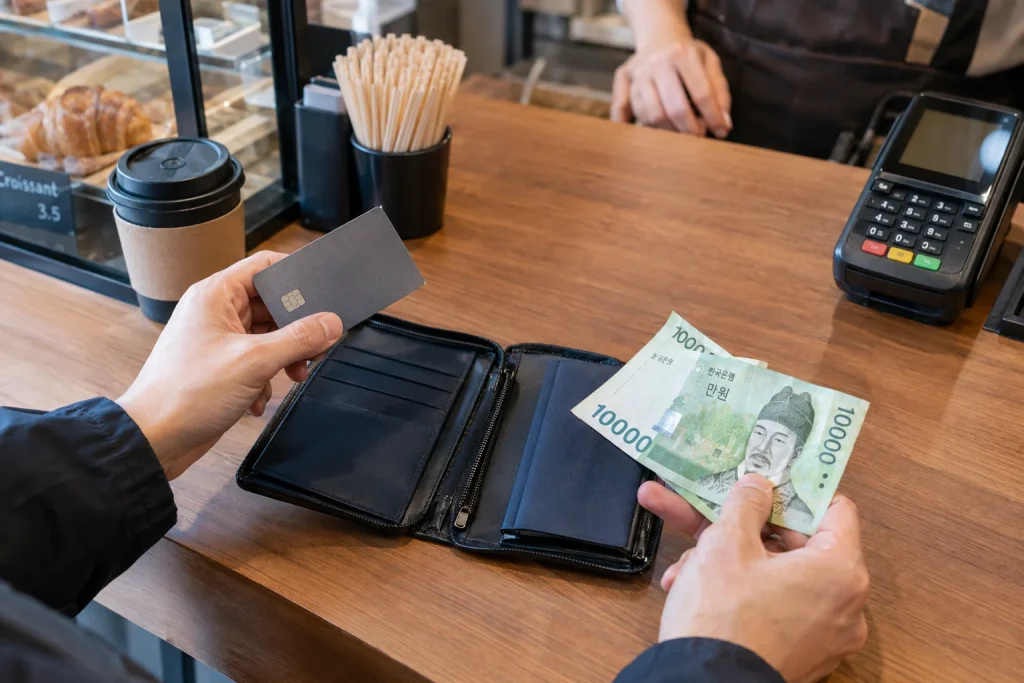
Cash or card in South Korea is an easier question than many first-time visitors expect.
South Korea is highly card-friendly. International visitors can pay by card at many hotels, department stores, convenience stores, restaurants, cafes, and other everyday businesses.
But that does not mean you should arrive with no cash at all.
The most practical approach for most travelers is to use a card for normal spending and carry a modest amount of Korean won as backup.
Cash or card in South Korea: the quick answer
For most visitors, the best setup is:
- One primary international credit or debit card
- One backup card from another issuer if possible
- A small amount of Korean won in cash
- A transportation payment method appropriate for your trip
You usually do not need to carry large amounts of cash.
Cash is best treated as backup for the situations where your card, app, terminal, or transportation payment method does not work as expected.
How widely are credit cards accepted in South Korea?
Korea is one of the most card-friendly travel destinations in Asia.
The Korea Tourism Organization states that credit cards are widely accepted at major hotels, department stores, general shops, and many other businesses.
International networks such as Visa, Mastercard, and American Express can be used at many merchants.
Still, card acceptance is not literally universal.
Where cards usually work well
International visitors can generally expect card acceptance at:
- Hotels
- Department stores
- Convenience stores
- Chain cafes
- Major restaurants
- Shopping malls
- Tourist attractions
- Large supermarkets
- Many pharmacies
- Most modern retail stores
These are the places where most travelers spend the majority of their money.
Where cash can still be useful
Cash remains useful in situations where payment infrastructure is less predictable.
Examples can include:
- Some traditional markets
- Small independent businesses
- Older payment terminals
- Temporary stalls or street vendors
- Certain transportation situations
- Emergency backup when a card is declined
Card acceptance at traditional markets has been improving, but it can still vary from stall to stall.
Traditional markets are becoming more card-friendly
Korean tourism authorities have been encouraging traditional markets to improve payment convenience for visitors.
In 2026, the Ministry of Culture, Sports and Tourism and the Korea Tourism Organization launched a campaign involving selected traditional markets that included card acceptance among its service improvements.
This is useful progress for travelers, but it is still sensible to carry some cash when visiting a market.
How much cash should a traveler carry?
There is no universal amount because spending habits vary.
For many travelers, carrying enough cash to cover a few small purchases, a transportation problem, or one meal is more practical than carrying a large travel budget in banknotes.
The goal is not to pay for everything in cash.
The goal is to avoid being stranded if your main payment method temporarily fails.
Why two cards are better than one
Even if your main card works perfectly during most of your trip, a second card provides useful redundancy.
A card can fail because of:
- Bank fraud controls
- Temporary network problems
- Unsupported payment terminals
- Online transaction restrictions
- Card damage
- Lost or stolen cards
A backup card from another issuer or network can solve a problem immediately.
Keep your backup card separate
Do not store both cards in the same wallet if you can avoid it.
If your wallet is lost, having a second card in your hotel safe, travel pouch, or another secure location can be extremely useful.
This simple habit matters more than carrying a large amount of emergency cash.
Foreign cards can work in stores but fail in apps
One of the most confusing payment situations in Korea is that a foreign card can work normally at a physical store but fail inside a Korean app.
The reason is that a physical merchant terminal and a domestic app payment system may use different payment infrastructure.
An app may expect a Korean-issued card, local identity verification, or a domestic payment account.
This is why card acceptance should be considered separately for physical stores and Korean online services.
Contactless payment is useful but should not be your only plan
Some travelers prefer to pay entirely with a smartphone or smartwatch.
Contactless mobile payments can be convenient where supported, but compatibility depends on your device, card issuer, wallet service, and merchant terminal.
Carrying the physical card connected to your mobile wallet gives you a useful fallback.
Can you use foreign cards on Seoul public transportation?
Transportation payment rules in Seoul are changing.
Starting March 17, 2026, Seoul Metropolitan Government introduced international credit and debit card acceptance at new transit-card vending machines installed at 273 stations on subway Lines 1 through 8.
These machines can be used to purchase or recharge supported short-term Climate Cards and to buy single-journey tickets.
This makes arrival easier for visitors who previously needed cash or a domestic payment method for some ticket purchases.
Do not assume every transit gate directly accepts your foreign card
Using a foreign card at a ticket machine is not the same as tapping that card directly at every subway gate or bus reader.
Seoul is gradually expanding open-loop transportation payments, but travelers should still check the current rules for the exact service they plan to use.
A transportation card or appropriate visitor pass remains useful for regular public-transit use.
Climate Card payment options have improved
The short-term Climate Card is aimed at visitors who plan to use Seoul public transportation frequently.
With the new machines introduced in 2026, supported foreign-issued credit and debit cards can be used for eligible Climate Card purchases and recharges.
This reduces the need to exchange cash simply to begin using Seoul’s transit system.
AREX also accepts credit cards for single-use tickets
Airport transportation has also become more card-friendly.
The Korea Tourism Organization announced that travelers can purchase single-use AREX tickets with credit cards at stations between Incheon International Airport and Seoul Station.
This is particularly convenient immediately after arrival, when travelers may not yet have Korean won.
Why some cash is still helpful for transportation
Even with recent improvements, transportation systems can have different payment rules depending on the operator, ticket type, station, or machine.
A small cash reserve helps if:
- A particular machine does not support your card
- You need to recharge a transportation product with different rules
- A payment terminal is temporarily unavailable
- You need a small emergency fare
Should you exchange money before arriving?
You do not necessarily need a large amount of won before arrival.
Korea has banks and authorized currency-exchange services at airports and in major tourist areas.
For many travelers, exchanging or withdrawing a modest amount after arrival is enough.
Airport exchange rates and fees may differ from other locations, so travelers who care about exchange costs can compare options.
Using ATMs in Korea
ATMs can be useful for obtaining Korean won, but international-card support varies by machine.
Look for ATMs that clearly indicate support for overseas or global cards.
Your home bank may charge an overseas ATM fee, and the Korean ATM operator may also charge a fee.
Check both the withdrawal fee and the currency-conversion terms before confirming a transaction.
Dynamic currency conversion can cost more
Some terminals or ATMs may offer to charge you in your home currency instead of Korean won.
This is known as dynamic currency conversion.
The displayed home-currency amount can feel convenient, but the conversion rate may be less favorable than allowing your own card network or bank to convert the Korean-won transaction.
Read the screen carefully before selecting the currency.
Always know your card’s foreign-transaction fee
Two travelers can buy the same item with the same type of card and pay different total costs depending on their bank.
Your issuer may charge:
- Foreign transaction fees
- Currency conversion fees
- ATM withdrawal fees
- Cash-advance fees
A travel-friendly card with low foreign-transaction fees can reduce unnecessary costs.
What about prepaid cards for international travelers?
Korea has traveler-oriented prepaid payment products such as Trip.PASS and other foreigner-focused cards.
VISITKOREA describes Trip.PASS as an international-traveler card that combines payment and transportation-related functions and can be recharged through several methods.
These products can be convenient for travelers who prefer a Korea-focused payment method rather than relying entirely on their overseas card.
They are optional rather than essential for every trip.
Traveler cards can provide useful spending separation
Some visitors like prepaid travel cards because they create a separate budget for the trip.
This can make spending easier to track and reduce the need to expose a primary bank card during every purchase.
The trade-off is that you need to understand top-up rules, remaining balances, refunds, and any associated fees.
What should you use at a convenience store?
A card is usually the simplest choice.
Korean convenience stores commonly accept card payments, and they are useful places to buy food, drinks, travel necessities, and other small items.
They are also common locations for services related to transportation cards and traveler payment products.
What should you use at a restaurant?
Most established restaurants in major cities commonly accept cards.
If you are eating at a very small business, traditional market stall, or temporary vendor, keeping cash available is sensible.
When in doubt, you can ask before ordering.
What should you use at a traditional market?
Bring both.
Card acceptance is improving and many market merchants accept cards, but cash gives you the most flexibility when moving between different stalls.
Small denominations are useful so you do not need to break a large banknote for a minor purchase.
What should you use in a taxi?
Korean taxis generally provide multiple payment options, but the exact method can depend on how the ride was booked and which service you use.
If you book through an international-friendly mobility app, check whether the fare is paid through the app or inside the taxi.
Keeping both a card and some cash available prevents unnecessary confusion.
What if your card is declined?
Do not immediately assume that the merchant does not accept foreign cards.
Try the following:
- Try the physical card if mobile payment failed.
- Try your second card.
- Check your banking app for a security alert.
- Confirm overseas transactions are enabled.
- Ask whether the merchant can retry the transaction.
- Use cash if the purchase is small and urgent.
Do not carry excessive cash
Because card acceptance is widespread, most travelers do not need to carry their full travel budget in cash.
Large amounts of cash create unnecessary loss and theft risk.
Keep only the amount you realistically expect to need as backup and obtain more later if necessary.
A practical payment setup for most travelers
A simple and resilient setup is:
- Primary international Visa or Mastercard
- Second card stored separately
- Physical version of your mobile-wallet card
- A modest amount of Korean won
- A transportation card or visitor transit product
This covers almost every normal payment situation without making the trip unnecessarily complicated.
Cash or card in South Korea for a first-time visitor
Use your card by default.
Use cash when it is clearly easier, when a small merchant prefers it, or when your primary electronic payment method is unavailable.
There is no need to turn the trip into an all-cash experience, but there is also little benefit in refusing to carry any cash at all.
Bottom line
Cash or card in South Korea does not need to be an either-or decision.
Cards are widely accepted across everyday Korean businesses, and recent transportation improvements have made international cards even more useful for visitors.
But a small amount of Korean won remains valuable for traditional markets, smaller merchants, transportation exceptions, and emergency backup.
For most international travelers, the strongest setup is simple: use cards for everyday spending, keep a second card separate, and carry a modest cash reserve.
Related BestSpot Guides
- how mobile payments work in South Korea for foreign visitors
- why foreign credit cards fail in some Korean apps
- how to use Korean taxis without speaking Korean
Sources
- VISITKOREA — Korean Currency and Credit Card Information
- Seoul Metropolitan Government — International Cards for Subway Ticket Machines
- VISITKOREA — AREX Single-Use Tickets by Credit Card
- VISITKOREA — Trip.PASS for International Travelers
- VISITKOREA — Traditional Market Card-Payment Improvements
Updated: September 2026. Card acceptance, transit payment methods, fees, traveler-card products, and merchant payment options can change. Confirm current information when a specific payment method is essential.