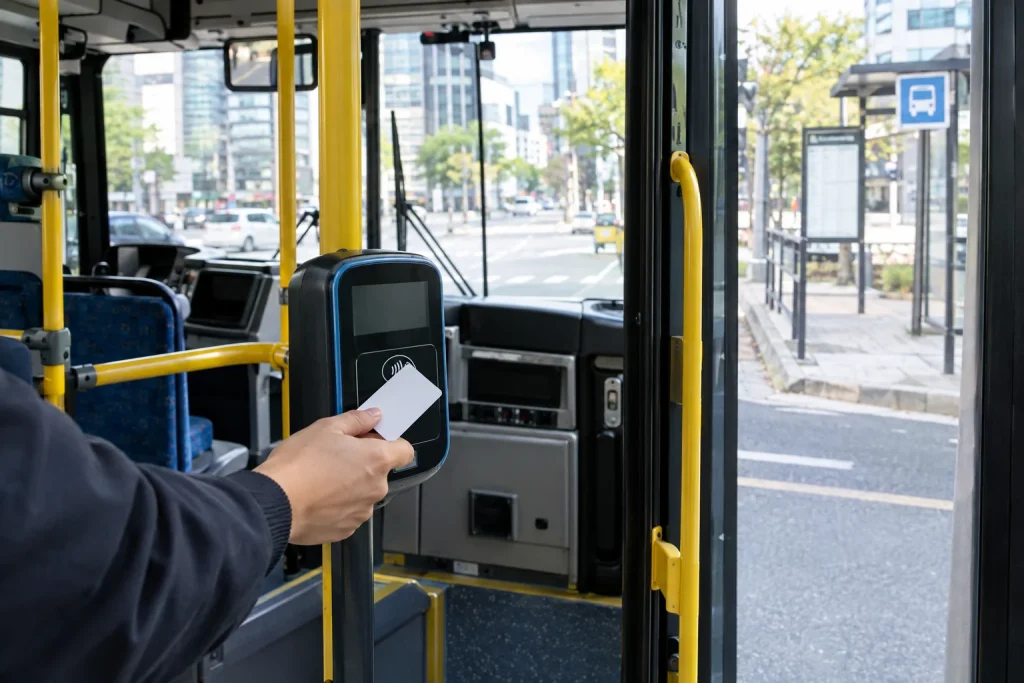
How to use Seoul buses becomes much easier once you understand a few simple rules: check the route before boarding, tap your transportation card when you get on, watch the stop information carefully, press the stop button before your destination, and tap again when you get off.
For first-time visitors, Seoul buses can look more complicated than the subway because there are many routes and stops. But buses are often the fastest way to reach neighborhoods, restaurants, attractions, and residential areas that are not directly beside a subway station.
How to use Seoul buses: the quick answer
The basic routine is simple:
- Find the correct bus number and stop.
- Check the direction before boarding.
- Enter through the front door.
- Tap your transportation card.
- Watch the upcoming stops.
- Press the stop button before your destination.
- Exit through the rear door.
- Tap your card again when getting off.
Why Seoul buses are useful for visitors
The subway is excellent for long-distance travel across Seoul, but many places are still a walk away from the nearest station.
Buses can reduce that walking distance and often connect directly to:
- Residential neighborhoods
- Traditional markets
- Universities
- Parks
- Hotels
- Shopping streets
- Restaurants and cafes
Use a Korean map app before boarding
The easiest way to use Seoul buses is to plan the trip in a local map app before reaching the bus stop.
NAVER Map and KakaoMap can show:
- Bus number
- Boarding stop
- Direction
- Estimated arrival time
- Number of stops remaining
- Transfer information
- Walking route after getting off
Do not rely only on seeing the correct bus number. You also need to confirm that the bus is traveling in the correct direction.
The same bus number can travel in two directions
This is one of the most common mistakes visitors make.
A route may have stops on opposite sides of the street for different directions.
If your map app tells you to board at a specific stop, make sure you are standing at that exact stop rather than another stop with the same bus number nearby.
Check the bus stop ID
Many Seoul bus stops have a unique stop identification number.
This number can be useful when several stops have similar names or when there are multiple bus stops near a large intersection.
If your map app shows a stop ID, compare it with the number displayed at the physical stop.
Real-time arrival information is very useful
Seoul provides real-time bus arrival information through public transportation systems and map apps.
You can often see:
- How many minutes until the bus arrives
- How many stops away it is
- Whether another bus on the same route is approaching
This makes it easier to decide whether to wait or choose another route.
Bus stop displays can help too
Many major bus stops have electronic displays showing upcoming buses and estimated arrival times.
These displays are useful when your phone battery is low or when you want to confirm the information shown in an app.
Enter through the front door
On a typical Seoul city bus, passengers board through the front door.
The transportation card reader is located near the driver.
Tap your card once as you board.
Use a transportation card
A rechargeable transportation card such as T-money is the easiest way for visitors to pay bus fares.
Using a transportation card is especially useful because it can also support transfer discounts between buses and subways.
Cash payment does not provide the same transfer benefits.
Tap when boarding
Place your transportation card on the card reader near the front entrance.
You should hear a confirmation sound and normally see the fare or balance information on the reader.
If the card is rejected, try again carefully or check whether the balance is too low.
Watch the stop announcements
Seoul buses typically provide upcoming-stop information inside the vehicle.
Depending on the bus, this may include:
- Audio announcements
- Electronic displays
- Korean station names
- English information on major routes
Even when English is available, keeping your map app open can make the trip easier.
Track your location on the map
A useful habit is to watch your position move along the route in NAVER Map or KakaoMap.
This reduces the risk of missing your stop if the English announcement is difficult to hear or if the stop name sounds different from what you expected.
Press the stop button before getting off
When your destination is approaching, press one of the stop-request buttons inside the bus.
This signals to the driver that a passenger wants to get off at the next stop.
Do not wait until the bus has already reached the stop.
When should you press the stop button?
A practical rule is to press it after the bus leaves the stop immediately before your destination.
If your map app says “1 stop remaining,” that is usually a good time to prepare to get off.
Move toward the rear door when it is safe to do so.
Exit through the rear door
On most Seoul city buses, passengers leave through the rear door.
A transportation card reader is located near the exit.
Tap your card again before stepping off.
Why you should tap when getting off
The exit tap is important for fare calculation and transfers.
VISITKOREA explains that passengers using a transportation card should tap when boarding and again when leaving.
Without the exit tap, the system may not calculate the trip or transfer eligibility correctly.
How bus transfers work in Seoul
Seoul’s integrated public transportation system allows eligible transfers between buses and subways when you use a transportation card.
According to VISITKOREA, transfer benefits generally require you to tap when leaving the first vehicle and then board the next eligible bus or subway within the allowed transfer window.
The exact fare can still depend on distance and route.
How long do you have to transfer?
VISITKOREA currently explains that Seoul’s transfer window is generally:
- 30 minutes between 07:00 and 21:00
- 60 minutes between 21:00 and 07:00
Transfer rules can change and may differ in other Korean cities.
The same bus route usually does not count as a transfer
Getting off one bus and boarding another bus with the same route number generally does not qualify as a free transfer under the normal Seoul transfer rule.
The transfer system is designed for moving between different routes or between bus and subway services.
Bus colors have different roles
Seoul buses use several color categories.
Visitors commonly see blue, green, yellow, and other bus types.
The color helps identify the general function of the route, but you do not need to memorize the entire color system before traveling.
The route number and destination shown in your map app are more important for most visitors.
Night buses use N route numbers
Seoul also operates late-night bus services.
These routes commonly use an N in the route number.
Night-bus routes can be useful after ordinary subway service has ended, but always check the latest schedule before relying on one.
What if the bus is crowded?
During commuting hours, buses can be very crowded.
Keep your bag close, move away from the entrance when possible, and prepare for your stop early.
If the rear door is crowded, start moving toward it before the bus reaches your destination.
What if you miss your stop?
Do not panic.
Get off at the next safe stop, then use your map app to check whether it is easier to walk back, take another bus, or use the subway.
Do not try to ask the driver to stop between official bus stops.
A practical bus routine for first-time visitors
- Search your destination in NAVER Map or KakaoMap.
- Select the recommended bus route.
- Confirm the exact boarding stop and direction.
- Check the bus number before boarding.
- Enter through the front door.
- Tap your transportation card.
- Track the route on your phone.
- Press the stop button one stop before your destination.
- Move toward the rear exit.
- Tap your transportation card again.
- Follow the walking directions to your final destination.
Common mistakes visitors make on Seoul buses
- Standing at the stop for the opposite direction
- Boarding the correct bus number in the wrong direction
- Forgetting to tap when getting off
- Waiting too long to press the stop button
- Relying only on English announcements
- Assuming a bus stop name is the same as the destination name
- Ignoring the final walking route after leaving the bus
Bottom line
How to use Seoul buses is mostly about preparation rather than memorizing the entire bus network.
Use a local map app, confirm the exact stop and direction, tap your transportation card when boarding, press the stop button before your destination, and tap again when getting off.
Once you follow that routine a few times, Seoul buses become one of the most useful ways to reach places beyond the subway network.
Sources
- VISITKOREA — City Bus Guide
- Seoul Metropolitan Government — Public Transportation Guide
- VISITKOREA — Transportation Cards
Updated: September 2026. Bus routes, fares, transfer rules, schedules, and real-time service information can change.