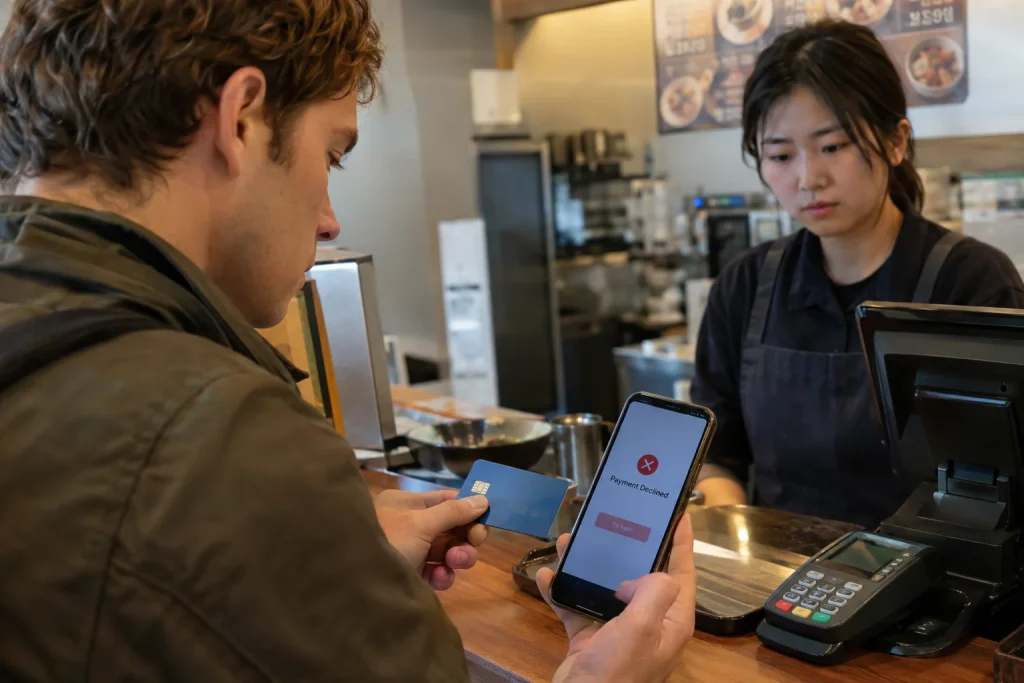
Foreign credit cards in Korean apps can be surprisingly inconsistent. A Visa or Mastercard may work perfectly at a restaurant, hotel, convenience store, or physical payment terminal, yet the same card may be rejected when you try to pay inside a Korean app.
For international visitors, this can feel confusing because the card itself is clearly working. In many cases, however, the problem is not simply whether the card is valid. The app’s payment system, account requirements, identity verification process, or supported card types may be different from those used at a physical store.
Understanding that distinction makes payment problems in Korea much easier to diagnose.
Why foreign credit cards in Korean apps can fail
There is no single reason every foreign card is rejected. Different Korean apps use different payment systems and account rules.
Common reasons include:
- The app accepts only Korean-issued cards for a particular payment flow
- The service requires a Korean phone number or identity verification
- The account is not eligible for the payment feature
- The foreign card issuer blocks or flags the overseas transaction
- The app has a separate global service for international customers
- The payment method is supported offline but not inside that specific app
This is why the same card can work in one Korean service and fail in another.
A physical card terminal and an app are different systems
One of the most important things to understand is that paying at a physical store is not the same as paying inside an app.
At a store, the merchant’s payment terminal may accept an internationally issued Visa, Mastercard, or other supported network card directly.
Inside an app, however, the payment process may be connected to a domestic account system, Korean identity verification, or a payment method originally designed around Korean residents.
So a successful physical purchase does not guarantee that the same card will work in every Korean app.
Some Korean services were designed primarily for domestic users
Many Korean digital services were originally built for people who live in Korea and already have the local infrastructure needed to use them.
That infrastructure can include:
- A Korean mobile phone number
- A locally verified identity
- A Korean-issued credit or debit card
- A domestic bank account
- A Korean address
For a local resident, these requirements may be nearly invisible because they are already part of everyday digital life.
For a visitor, they can appear suddenly at checkout.
Foreign card support may exist only in a global version
Some Korean companies solve this problem by offering a separate global service for international users.
CATCHTABLE is a good example.
The Korea Tourism Organization notes that some Korean restaurant reservation systems require a Korean phone number or do not accept foreign credit cards. CATCHTABLE GLOBAL was designed specifically to remove those barriers.
Its international version allows users to create an account without a Korean phone number and supports payment with foreign-issued credit cards.
This illustrates an important rule: if the domestic version of a Korean service rejects your card, check whether the company offers a separate global version.
Korean phone verification can be part of the payment problem
A card may not actually be the first thing preventing a transaction.
The service may require identity verification before it even allows the payment method to be registered.
In Korea, mobile verification can involve more than receiving an SMS code. The phone number may need to be connected to verified identity information.
Our guide to Korean phone verification explains how that process differs from ordinary SMS verification.
NAVER’s 2026 passport verification shows how the system is changing
In June 2026, NAVER introduced passport-based verification for foreign visitors.
According to NAVER, users with passports issued outside Korea can use the new verification method to access NAVER Booking, NAVER Order, and payment-related services without needing a Korean mobile phone number.
The change is significant because it removes one of the traditional barriers that foreign visitors encountered when trying to use Korean digital services.
It also shows that Korean platforms are actively redesigning parts of their domestic systems for international users.
Taxi apps show the same domestic-versus-global pattern
Transportation apps provide another useful example.
The Korea Tourism Organization recommends k.ride, a traveler-focused mobility service operated by Kakao Mobility.
Unlike some domestic services that can be difficult for non-residents to register for, k.ride supports overseas credit card registration and international-friendly account options.
For visitors, choosing the traveler-oriented version of a service can therefore be easier than trying to force a domestic payment workflow to accept an unsupported card.
Food delivery apps can create similar problems
Food delivery is another area where international visitors can encounter payment and account restrictions.
Some domestic delivery services are deeply integrated with Korean phone verification, addresses, and local payment systems.
The Korea Tourism Organization highlights Shuttle Delivery as a foreigner-friendly alternative because users can sign up without a Korean phone number and pay with international credit cards or PayPal.
The existence of these international-focused services is useful evidence that the difficulty is often not the physical credit card itself, but the domestic service workflow surrounding it.
Why your foreign card may work in one app but not another
Card acceptance is determined by the individual service and payment flow.
One app may support overseas cards directly. Another may accept them only through its global version. A third may require a domestic payment method.
Even within the same platform, different products can have different payment rules.
This means there is no reliable rule such as “Visa always works” or “Mastercard never works.” You need to check the specific service.
Your own card issuer can also reject the payment
Not every failed transaction originates in Korea.
Your home bank or card issuer may decline an overseas online transaction because of:
- International transaction settings
- Fraud prevention
- Unusual spending patterns
- Online payment restrictions
- Temporary security blocks
If a service clearly states that it accepts overseas cards but your payment still fails, checking your issuer’s app or contacting the issuer can be useful.
Do not confuse card acceptance with mobile wallet acceptance
A card being stored in Apple Pay, Google Wallet, or another mobile wallet does not automatically mean that every Korean app can use that card.
The Korean service still needs to support the relevant wallet or payment method.
Likewise, domestic wallets such as NAVER Pay and Kakao Pay may have their own account, verification, and payment requirements.
For a broader explanation, see our guide to mobile payments in South Korea for foreign visitors.
Foreign cards are becoming easier to use in transportation
South Korea is gradually expanding international card acceptance in areas that previously required cash or domestic transit products.
For example, Seoul introduced international credit and debit card support at new subway ticket machines in 2026 for short-term Climate Cards and single-journey tickets.
The Korea Tourism Organization also lists a growing number of traveler-oriented transportation services that accept foreign-issued credit cards.
This means older travel advice about payment limitations can become outdated quickly.
A useful strategy when an app rejects your card
If a Korean app declines your foreign credit card, try this sequence:
- Check whether the service officially supports international cards.
- Look for an English or global version of the service.
- Check whether the account requires Korean phone or identity verification.
- Try another international card if available.
- Check your card issuer for an overseas transaction block.
- See whether payment can be completed in person instead of inside the app.
- Use a traveler-focused alternative service when practical.
Why carrying a second card is useful
Even if your primary card works normally in Korea, carrying a second card is sensible.
A backup card from another issuer or network can help if your main card is temporarily blocked, unsupported by a particular payment provider, or rejected for security reasons.
This is especially useful when making time-sensitive reservations or transportation purchases.
Should travelers get a Korea-focused prepaid card?
Some visitors prefer prepaid or traveler-focused cards designed specifically for Korea.
Services such as WOWPASS and Trip.PASS combine payment functions with features aimed at international travelers.
These can be useful for people who want a Korea-based payment option without depending entirely on their overseas card.
However, they are not mandatory. Many visitors can travel successfully using international cards, some cash, and traveler-friendly apps.
Choose apps designed for international visitors when possible
The easiest solution is often not to fight with a domestic-only payment flow.
Services such as CATCHTABLE GLOBAL, k.ride, and other traveler-focused apps exist specifically because international users have different account and payment needs.
Our guide to essential apps for South Korea travel covers several useful traveler-oriented options.
Bottom line
Foreign credit cards in Korean apps may fail even when the same card works perfectly at a physical Korean store.
The reason is often that app payments are part of a broader domestic system involving account eligibility, identity verification, Korean phone numbers, or locally supported payment methods.
Before assuming your card is defective, check whether the service accepts overseas cards, offers a global version, or requires Korean verification.
As Korean platforms continue adding passport verification, global versions, and overseas card support, these barriers are gradually becoming easier for international visitors to navigate.
Sources
- VISITKOREA — CATCHTABLE Global and foreign card support
- VISITKOREA — Shuttle Delivery for foreign visitors
- VISITKOREA — Taxi and k.ride guide
- NAVER — Passport Verification for foreign visitors
- Korea Tourism Organization — 2026 International Visitor Transportation Guide
Updated: September 2026. Card acceptance, account requirements, identity verification, and payment options vary by service and can change over time.