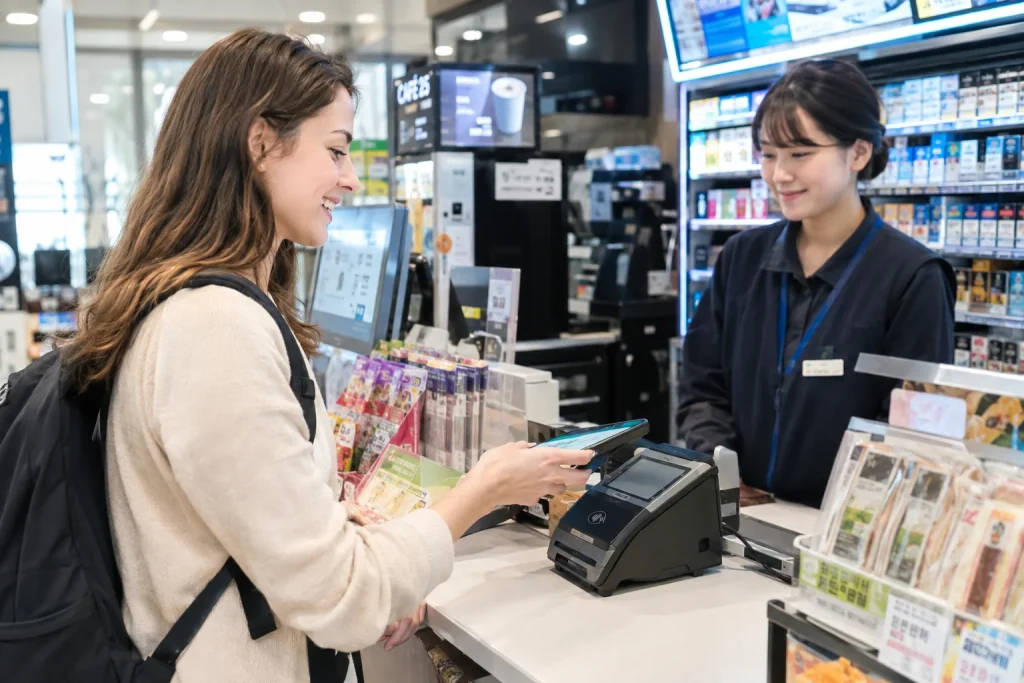
Mobile payments in South Korea can feel surprisingly easy in one situation and unexpectedly difficult in another. International visitors may be able to use a foreign Visa or Mastercard at a department store, hotel, restaurant, or subway ticket machine, yet still discover that a Korean app refuses their card or asks for local identity verification.
The reason is that “paying by phone” in Korea covers several different systems: international card payments, Korean mobile wallets, QR payments, transit cards, app-based payments, and identity-linked domestic payment services.
Understanding the difference between them can save travelers a lot of frustration.
Mobile payments in South Korea: the quick answer
For most short-term visitors, the simplest payment strategy is still to carry an internationally enabled Visa or Mastercard and keep a small amount of cash available.
Foreign cards work at many hotels, department stores, convenience stores, restaurants, and major tourist businesses. However, acceptance is not universal, especially inside Korean apps and online services.
Local mobile wallets such as Naver Pay and Kakao Pay are deeply integrated into Korea’s domestic payment ecosystem, but some functions may require a Korean phone number, local identity verification, or a Korean-issued payment method.
Why paying in a store can be easier than paying inside an app
A physical card terminal and a Korean mobile app may use completely different payment systems.
At a physical shop, an internationally issued card can often be processed through a global card network. The merchant terminal recognizes the card and sends the transaction through the relevant payment network.
Inside a Korean app, however, the payment service may be designed primarily for domestic users. It may require:
- A Korean-issued credit or debit card
- A Korean bank account
- A Korean mobile number
- Identity verification
- A domestic payment account
This is why a foreign card that works perfectly at a restaurant counter can still fail when the same restaurant’s app asks you to pay in advance.
International credit cards in Korea
Visa and Mastercard are widely accepted at many larger businesses in South Korea, particularly in major cities and tourist areas.
International visitors should still keep a backup payment method because acceptance can vary by merchant, terminal, card issuer, and transaction type.
A foreign card can also fail for reasons unrelated to Korea itself, including overseas transaction blocks, fraud controls, or issuer security settings.
What changed for Seoul subway payments in 2026
One of the most useful recent changes for travelers is happening in Seoul’s public transportation system.
Starting March 17, 2026, Seoul Metropolitan Government introduced international card payment support at 440 new transit card vending machines installed at 273 stations on Seoul Metro Lines 1 through 8.
At those machines, international visitors can use internationally issued credit and debit cards such as Visa and Mastercard to purchase certain transit products.
The supported products include:
- Single-journey subway tickets
- Short-term Climate Card passes
- Recharge of eligible short-term Climate Card passes
Supported short-term Climate Card durations include 1, 2, 3, 5, and 7 days.
Seoul also states that mobile payment services such as Kakao Pay and Naver Pay are supported at the new machines.
Be aware of the international card service fee
Convenience can come with an additional cost.
According to Seoul Metropolitan Government, purchases or recharges made with internationally issued credit or debit cards at the new transit machines may include an average service fee of approximately 3.7 percent.
That does not necessarily make the service a bad choice. For a traveler who would otherwise need to find cash or a compatible domestic payment method, the convenience may be worth the fee.
What is the Climate Card?
The Climate Card is Seoul’s public transportation pass system. Short-term versions are designed to be useful for visitors who plan to use Seoul’s buses and subway system frequently during a short stay.
Seoul currently offers short-term passes for several durations, including 1, 2, 3, 5, and 7 days.
The exact coverage and product structure can change, so travelers should check current Seoul Metropolitan Government or Tmoney information before purchasing.
Can you simply tap a foreign credit card on every Seoul bus or subway?
Not yet.
This is an important distinction. Being able to use an overseas card at selected ticket machines is not the same as having universal open-loop transit payments throughout Seoul.
Seoul has announced a phased plan to introduce an EMV-based open-loop payment system that would eventually allow travelers to use compatible overseas cards more directly across public transportation.
The city describes this as a multi-year transition extending through 2030, involving buses, rail operators, payment companies, and regional transportation systems.
So travelers should not assume that every subway gate or bus reader currently accepts a foreign contactless card directly.
What about Apple Pay and Samsung Wallet?
Mobile wallet compatibility depends on the card, device, merchant terminal, and underlying payment network.
Samsung’s mobile payment ecosystem has historically been deeply integrated into Korean payment and transit services, particularly on compatible Android devices.
Apple Pay is also available in Korea, but support for individual cards, merchants, transit functions, and app-based payments can differ from what users experience in their home country.
The important point is that adding a foreign card to a mobile wallet does not automatically make it equivalent to a Korean-issued card inside every Korean service.
Naver Pay and Kakao Pay
Naver Pay and Kakao Pay are two major Korean payment platforms.
They are widely integrated with Korean online shopping, local services, QR payments, and participating physical merchants.
For residents with local identity verification and domestic payment methods, these services can be extremely convenient.
For a short-term visitor, however, account creation and payment setup may be more complicated because some services are linked to Korea’s domestic identity and banking infrastructure.
QR payments are becoming more international
Seoul is also expanding QR-based payment interoperability.
In 2026, the city announced further integration of Seoul Pay+ QR codes with payment terminals and said the Seoul Standard QR system was being opened to dozens of global mobile payment applications.
The stated goal is to make QR payments easier for international visitors while allowing merchants to accept a wider range of mobile payment services.
This is another sign that Korea’s payment environment is becoming more accessible to travelers, although availability can still vary by merchant and payment app.
Why Korean mobile payments can require identity verification
Domestic payment services may require stronger verification than simply proving that you possess a phone.
Depending on the service, payment setup can involve a Korean mobile number, local identity verification, a domestic financial account, or a card issued in the user’s own name.
This is one reason visitors may find browsing and ordering easy until they reach the final payment screen.
Do you still need cash in South Korea?
South Korea is highly card-friendly, and many travelers can complete most daily purchases without using much cash.
Still, carrying a modest amount of Korean won is useful.
Cash can help with:
- Small traditional markets
- Older or smaller businesses
- Certain transportation situations
- Payment terminal problems
- Cards blocked by an overseas issuer
- Services that do not accept your specific foreign card
A small cash backup is less about Korea being a cash-based country and more about avoiding inconvenience when one payment method fails.
A practical payment setup for visitors
For most short-term travelers, a simple layered setup works best.
- Bring at least one internationally enabled Visa or Mastercard.
- If possible, bring a second card from a different issuer or network.
- Notify your card issuer of international travel if required.
- Keep a small amount of Korean won for backup.
- Use a transit card or an appropriate Seoul visitor transit pass for public transportation.
- Do not depend on a Korean mobile wallet unless you have confirmed that your account and payment method are supported.
What if your foreign card is declined?
First determine whether the failure is happening at the merchant, card network, or issuing bank.
Try another card if you have one. If the card works elsewhere but repeatedly fails inside a particular Korean app, the issue may be the app’s domestic payment requirements rather than your card itself.
For an essential purchase, asking whether payment can be made directly at the business can sometimes avoid an app-based payment restriction.
The payment environment is changing quickly
South Korea’s payment system is not standing still.
Seoul is actively expanding international card acceptance in transportation, working toward open-loop transit payments, and increasing interoperability between Korean QR systems and global mobile payment services.
For travelers, this means payment should become easier over time, but information from even a year or two ago can already be outdated.
Bottom line
Mobile payments in South Korea are highly advanced, but much of the ecosystem was originally designed around domestic users, Korean identity verification, local cards, and Korean financial accounts.
International visitors can use foreign cards in many everyday situations, and recent changes have made public transportation payments easier as well.
The safest strategy is to combine a widely accepted international card, a backup payment method, and a small amount of cash rather than relying on one mobile wallet for everything.
Sources
- Seoul Metropolitan Government — International cards for Climate Cards and single-journey tickets
- Seoul Metropolitan Government — Climate Card guide
- Seoul Metropolitan Government — Open-loop payments for international tourists
- Seoul Metropolitan Government — Seoul Pay QR expansion
Updated: September 2026. Payment acceptance, transit products, fees, and mobile wallet support can change. Confirm current information with the relevant provider before relying on a specific payment method.