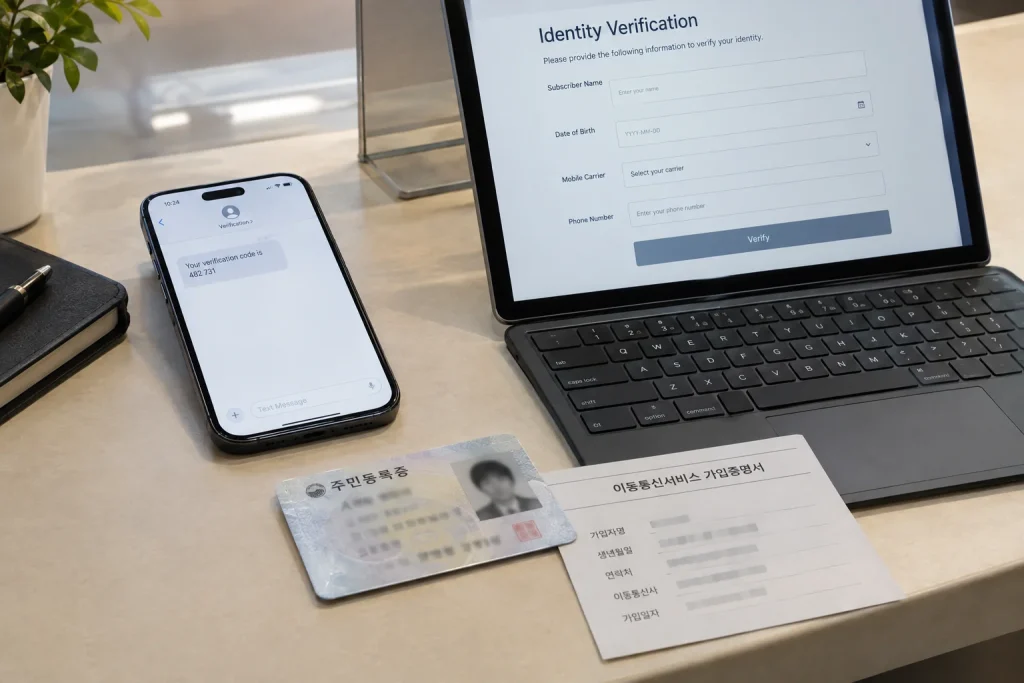
Korean phone number identity verification is one of the most confusing parts of digital life in South Korea for foreign visitors and new residents.
You may have a Korean 010 phone number, receive calls and text messages normally, and still discover that a website or app refuses to verify your identity.
The reason is simple: having a working phone number and passing Korean mobile identity verification are not the same thing.
Korean phone number identity verification: the key difference
A Korean mobile number can perform several different jobs.
It can receive calls, connect to mobile data, and receive ordinary SMS messages. But formal mobile identity verification asks for something more: whether the personal information you entered matches the subscriber information registered with the mobile carrier.
That distinction explains why one Korean number may work perfectly for receiving a six-digit code but fail when a service asks for real-name verification.
Receiving an SMS code is not the same as proving your identity
Many international users naturally assume that phone verification means receiving a text message.
In a simple SMS confirmation, a service sends a one-time code to a number. Entering the correct code proves that you currently have access to that phone number.
Formal Korean mobile identity verification can go further.
The verification system can compare information such as:
- Mobile carrier
- Subscriber name
- Date of birth
- Nationality or foreigner status
- Phone number
- Other identity information registered with the carrier
If that information does not match, the verification can fail even though the phone itself works normally.
Why a Korean 010 number alone is not enough
A 010 number tells you that you have a Korean mobile number.
It does not by itself tell an app who legally owns the line or what identity information the carrier has registered for that subscriber.
This matters because Korean mobile identity verification is designed to connect a phone subscription with a real person.
The Korea Customs Service provides a useful official example. Its mobile verification instructions tell foreign users to select the carrier and enter the personal information that was registered when the mobile subscription was created.
Your subscriber name must match your identity record
This is one of the most important details for foreign residents.
The Korea Customs Service specifically states that the name on a foreign user’s Alien Registration Card and the mobile-phone subscriber name must match for mobile identity verification.
If those names are different, verification can fail.
This can happen because of:
- Different spacing in a name
- Different ordering of given name and family name
- Missing middle names
- Romanization differences
- A phone subscription registered with different information
Foreign names can make matching more complicated
Korean identity databases were originally designed around standardized domestic identity records.
Foreign names can be longer and can appear in different orders or spellings across passports, residence documents, bank accounts, and mobile subscriptions.
Even small differences can matter when an automated service expects the information to match the carrier’s subscriber record.
For this reason, foreign residents should pay attention to the exact name registered when opening a Korean mobile line.
Why tourist SIMs and resident phone plans can behave differently
A travel SIM is primarily designed to provide communication during a short visit.
Its purpose may be mobile data, calls, or SMS rather than integration with Korea’s resident identity infrastructure.
A resident mobile subscription, by contrast, can be registered against the subscriber’s Korean residence and identity information.
The important question is therefore not simply whether the SIM provides a Korean number. It is what identity information is connected to that number and whether the service you are using supports that verification method.
Passport registration and resident identity are not always equivalent
Foreign visitors commonly purchase Korean telecom products using a passport.
That is enough for many travel communication needs.
But a Korean online service may require identity information that is tied to a resident record rather than simply proving that someone presented a passport when buying a SIM.
This is why a traveler can legitimately own and use a Korean phone number without automatically gaining access to every domestic identity-verification flow.
What PASS verification does
PASS is one of the common interfaces people see when Korean websites request mobile identity verification.
The Korea Customs Service documentation shows mobile identity verification flows that involve selecting the user’s telecommunications company and entering personal details.
The verification is therefore not based only on possession of a phone.
The information entered by the user must correspond to information associated with the mobile subscription.
SMS authentication can still ask for personal information
Even when the verification screen offers an SMS-based option rather than an app-based option, it can still be part of a formal identity check.
The Korea Customs Service example asks users to provide information such as name, date of birth, mobile carrier, and phone number before the verification process is completed.
So the word “SMS” does not necessarily mean that any phone capable of receiving a text message will pass.
Why Korean apps use this system
Mobile identity verification gives Korean services a standardized way to confirm that an account is connected to a person whose identity information is registered with a telecom provider.
Depending on the service, this can be used for:
- Account recovery
- Age verification
- Financial services
- Government services
- Payments
- Shopping
- Regulated services
Each service can still apply its own eligibility and verification rules.
NAVER provides a useful example
NAVER distinguishes ordinary account access from stronger real-name or age verification.
Its help documentation explains that users who cannot perform real-name verification with a Korean mobile phone registered in their own name may need a different verification process in certain circumstances.
This illustrates the same principle: controlling a phone number is different from having a mobile subscription that can be used as a verified identity credential.
Your carrier information matters
When a verification screen asks which mobile carrier you use, the answer needs to correspond to the actual carrier handling your subscription.
Korean verification systems may list the major carriers as well as separate options for MVNO or budget-phone services.
Selecting the wrong carrier can cause verification to fail even if every other field is correct.
MVNO does not simply mean verification cannot work
Budget mobile services use the networks of Korea’s major telecommunications companies but operate under their own subscription arrangements.
Verification screens commonly provide a separate MVNO or budget-phone selection.
The important factors remain whether the line and subscriber information are eligible for the particular verification service and whether the information entered matches the carrier record.
Why date of birth and foreigner status matter
Formal verification screens can request more than a name and number.
Official Korean verification examples include date of birth and whether the subscriber is Korean or non-Korean.
These fields help the system identify the correct person in the underlying subscriber record.
If you enter information in a different format from the carrier’s record, verification may fail.
Why Korean phone number identity verification can fail after changing carriers
If you recently opened a new account, changed providers, transferred a number, or updated your personal information, the various systems involved may not always reflect changes immediately.
When verification suddenly stops working after a telecom change, checking the subscriber information with the carrier is a sensible first step.
Do not automatically assume that the app itself is broken.
What to check when verification fails
If you have a Korean number but formal verification fails, check these items systematically:
- Confirm the mobile carrier selected on the verification screen.
- Check the exact subscriber name registered with the carrier.
- Compare that name with your Korean residence document.
- Confirm your date of birth is entered in the requested format.
- Make sure you selected the correct Korean/non-Korean option.
- Check that the phone number is entered correctly.
- Ask the carrier whether the line supports the verification method you need.
The exact spelling of your name can be the problem
The Korea Customs Service explicitly advises foreign users whose verification repeatedly fails to check that the subscriber name matches the name on their Alien Registration Card.
This means that fixing a name mismatch with the telecom provider may solve a problem that cannot be fixed by repeatedly requesting another SMS code.
Do not keep retrying without checking the cause
When an identity check fails repeatedly, repeatedly pressing the verification button is rarely useful.
First determine whether the failure is:
- A missing SMS message
- Incorrect personal information
- A subscriber-name mismatch
- The wrong carrier selection
- An unsupported account or subscription type
- A service-specific eligibility restriction
Those are very different problems and require different solutions.
Can a traveler avoid Korean identity verification entirely?
For many short trips, yes.
Travelers can often use maps, translation, transportation, messaging, physical card payments, and international-friendly booking services without building a full Korean resident identity setup.
Korean platforms are also gradually adding alternative methods for foreign visitors, such as passport-based verification for selected services.
A tourist should therefore avoid assuming that every domestic app is essential.
Residents have different needs from tourists
A person living in Korea long term is much more likely to need mobile identity verification for banking, government services, online shopping, account recovery, and other everyday tasks.
For a resident, making sure that the mobile subscription is correctly registered with matching personal information becomes much more important.
A tourist staying for several days may never need to complete the same process.
Korean phone number identity verification is an identity system, not just a phone feature
This is the most useful way to think about the system.
Your Korean number is the communication channel, but the verification process can use the telecom subscription as a link to your registered identity.
If that identity link is missing, inconsistent, or unsupported by the service, simply owning the number does not solve the problem.
Bottom line
Korean phone number identity verification requires more than simply possessing a working Korean phone number.
A number may receive calls and SMS normally while formal identity verification fails because the service is checking subscriber information such as name, date of birth, carrier, and foreigner status.
For foreign residents, one of the most important checks is whether the name registered with the mobile carrier exactly matches the identity information used by Korean services.
For short-term visitors, the easier solution is often to use traveler-friendly services rather than trying to turn a temporary mobile connection into a complete Korean resident identity system.
Related BestSpot Guides
- why Korean apps ask for phone number verification
- Korean SIM card vs eSIM for visitors
- how to create a Naver account as a foreign visitor
Sources
- Korea Customs Service — Mobile Phone Identity Verification Guide
- Korea Customs Service — Identity Verification and Personal Customs Code Guide
- NAVER Help — Real-Name Verification When Mobile Verification Is Unavailable
- NAVER Help — Identity Confirmation for Foreign Users Living Overseas
Updated: September 2026. Mobile carrier procedures, identity-verification methods, and individual service requirements can change over time.