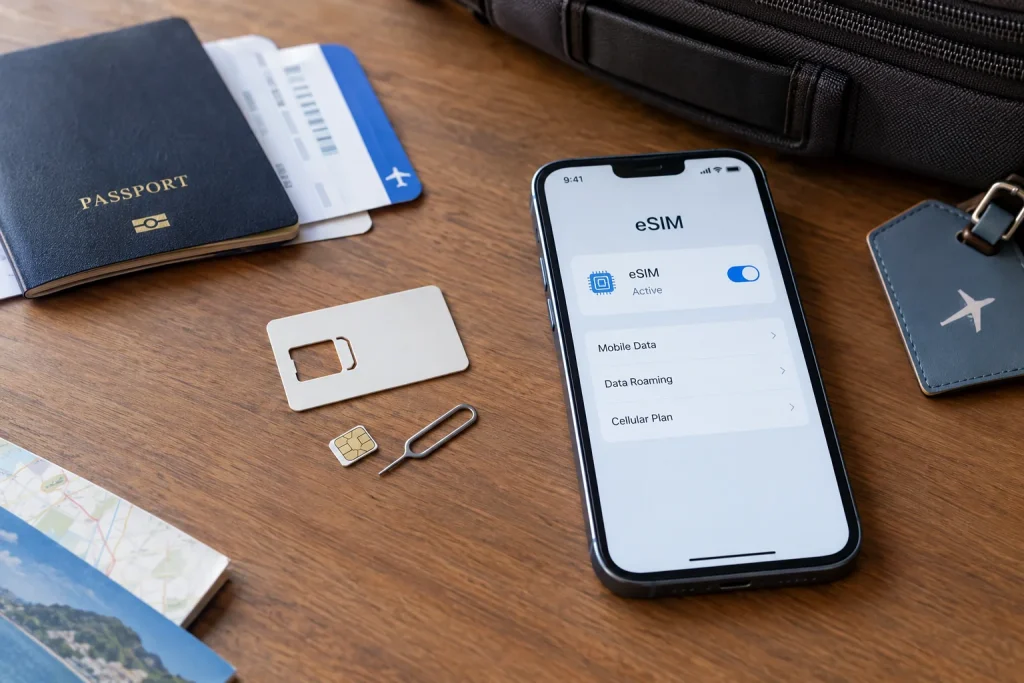
Korean SIM card vs eSIM is one of the first practical decisions international visitors make before arriving in South Korea.
Both options can give you mobile data on a Korean network, but they work differently. A physical SIM requires you to replace or add a small card inside your phone, while an eSIM installs a mobile plan digitally without inserting anything.
For many short-term travelers, either option can work well. The better choice depends on your phone, whether you need a Korean phone number, how comfortable you are changing SIM settings, and whether you want everything ready before landing.
Korean SIM card vs eSIM: the quick answer
If your phone supports eSIM and you mainly need mobile data, an eSIM is usually the simplest option because you can purchase and install it before or during your trip without handling a physical card.
A physical Korean SIM can be a better choice if:
- Your phone does not support eSIM
- You prefer staff to help with activation
- You want to buy the service after arriving
- You need a specific voice or SMS product
- You are more comfortable using a traditional SIM card
Neither option is automatically better for every traveler.
What is a physical Korean SIM card?
A physical SIM, often called a USIM in South Korea, is a small card inserted into your smartphone.
VISITKOREA explains that travelers can purchase physical USIM cards at roaming centers in major international airports, at some convenience stores and retailers, or online for airport pickup.
Once activated, the SIM connects your device to the Korean mobile network according to the plan you purchased.
What is an eSIM?
An eSIM performs the same basic network function without requiring a removable card.
The SIM information is downloaded to a compatible device.
VISITKOREA describes the usual process as purchasing an eSIM online and scanning the provider’s QR code to install the plan.
This is particularly convenient for travelers who want to arrange connectivity before they arrive in Korea.
Check whether your phone supports eSIM first
Before buying an eSIM, confirm that your exact smartphone model supports the feature.
This matters because eSIM availability can differ by model, country of purchase, and device configuration.
VISITKOREA specifically advises travelers to check device compatibility before purchasing an eSIM.
Do not assume that every recent smartphone automatically supports every eSIM plan.
Make sure your phone can use another carrier
Another important issue is whether your device can use a SIM or eSIM from a different mobile carrier.
A phone restricted to your home carrier can create problems with a Korean travel SIM.
Before leaving home, check your carrier settings or contact your provider if you are unsure whether your device can use an overseas SIM.
Why eSIM is convenient before departure
The biggest advantage of an eSIM is that there is no physical card to collect or replace.
You can often buy the plan online, receive installation instructions, and prepare the eSIM before your flight.
Depending on the provider, activation may begin only when the plan first connects to a supported Korean network, but travelers should always check the specific product conditions.
This can make arrival easier because you do not have to visit a telecom counter immediately after a long flight.
Why some travelers still prefer a physical SIM
Physical SIM cards remain useful because the process is familiar and staff assistance is widely available at major Korean airports.
For someone who does not want to change digital SIM settings, having airport staff install or activate a physical SIM can feel simpler.
It can also be useful when your phone has no eSIM capability.
Where can you buy a Korean physical SIM?
According to VISITKOREA, physical travel SIMs are available at several types of locations.
- Mobile carrier roaming centers at major international airports
- Selected convenience stores
- Selected retailers
- Online stores with airport pickup
Major airports including Incheon, Gimpo, Gimhae, and Jeju have carrier roaming centers serving international visitors.
Convenience-store availability varies by branch, so purchasing at the airport or arranging pickup in advance can be more predictable.
Can you buy an eSIM after arriving in Korea?
Yes, but there is usually little reason to wait if you already know which product you want.
Because an eSIM can generally be purchased online, many travelers prefer to arrange it before departure while they still have reliable home internet access.
Keep the QR code or installation information somewhere accessible in case you need it again during setup.
Does an eSIM give you a Korean phone number?
This depends on the product.
Some travel eSIMs are data-only, while others can include a Korean mobile number and support voice or SMS functions under certain conditions.
KT, for example, currently distinguishes between data-only eSIM products and products that can provide voice and SMS functions.
Its foreign-tourist products can have additional identity or entry-verification requirements before voice and SMS features become available.
Data-only eSIMs are enough for many tourists
If your trip mainly involves maps, messaging apps, translation, web browsing, reservations, and internet-based calls, mobile data may be all you need.
Apps such as messaging services can continue working over data even if the Korean plan itself does not provide traditional voice calls.
This makes a data-only eSIM appealing for short visits.
When a Korean phone number matters
A Korean phone number can be useful for certain reservations, local calls, delivery services, or businesses that expect a domestic contact number.
However, travelers should not assume that simply receiving a Korean 010 number means the number can complete every Korean identity-verification process.
Phone service and formal Korean identity verification are different things.
Voice and SMS can require additional verification
Some Korean tourist SIM products impose extra requirements before voice and SMS functions are enabled.
KT states that certain voice/SMS services for foreign-tourist SIM and eSIM products require identity verification or an entry check at an airport roaming center.
This is an important detail if receiving Korean SMS messages or making traditional calls is essential to your trip.
Can you keep your home SIM active with an eSIM?
Many modern dual-SIM phones can keep a physical home SIM and a Korean eSIM installed at the same time.
This can be very convenient because your home number remains available while Korean mobile data uses the travel eSIM.
However, the exact dual-SIM behavior depends on your device and carrier.
Be especially careful with your home SIM’s data roaming settings so you do not accidentally generate expensive roaming charges.
Physical SIM users should protect their original SIM
If you remove your home SIM card to install a Korean physical SIM, store the original card somewhere secure.
SIM cards are tiny and easy to lose while traveling.
A small SIM-card holder or sealed compartment in your passport wallet can prevent an inconvenient problem at the end of your trip.
Which option is easier at Incheon Airport?
Both options are straightforward.
If you already installed an eSIM, you may only need to enable it and confirm the correct mobile-data settings after arrival.
If you purchased a physical SIM or reserved one for pickup, Incheon Airport has mobile carrier roaming centers where travelers can collect products and receive assistance.
KT, for example, operates foreign-visitor service counters at both Incheon Airport terminals.
Korean SIM card vs eSIM for a short trip
For a short vacation, simplicity matters more than building a perfect Korean mobile setup.
An eSIM is attractive when:
- Your device supports it
- You mainly need data
- You want connectivity prepared before landing
- You want to keep your home physical SIM installed
A physical SIM is attractive when:
- Your device lacks eSIM support
- You want in-person setup assistance
- You are comfortable replacing your existing SIM
- The specific physical-SIM product better fits your voice or SMS needs
Korean SIM card vs eSIM for a longer stay
Visitors staying for several weeks may care more about a local phone number, calls, SMS, extensions, and account compatibility.
In that situation, compare the exact product terms rather than choosing only by physical SIM versus eSIM.
KT notes that its short-term foreign-tourist SIM products can be used only within the permitted visitor period and may have limits on extensions.
Your visa or length of stay may therefore influence which mobile plan makes sense.
Do not choose only by price
A very cheap plan may be fine if you only need basic data, but travelers should also compare:
- Data allowance or unlimited-data conditions
- Speed restrictions after heavy use
- Plan duration
- Whether voice is included
- Whether SMS can be received
- Whether a Korean phone number is provided
- Activation requirements
- Extension rules
- Customer support
The cheapest product is not always the most convenient product.
Public Wi-Fi is useful but should not be your only plan
South Korea has widespread public Wi-Fi in airports, stations, subways, and many public areas.
VISITKOREA notes that free public Wi-Fi is available in many common locations.
Still, relying entirely on public Wi-Fi can be inconvenient when you need navigation on the street, a taxi, a translation tool, or immediate access to a booking.
Having your own mobile data connection is much more reliable for everyday travel.
A practical setup before you fly
Before buying either option:
- Check whether your phone supports eSIM.
- Confirm that your phone can use another carrier.
- Decide whether you need data only or a Korean phone number.
- Check whether voice and SMS require additional verification.
- Compare the plan duration with the length of your trip.
- Save installation instructions before departure.
Which one should most travelers choose?
For travelers with a compatible phone who mainly want reliable mobile data, an eSIM is often the easiest starting point.
There is no card to lose, it can be arranged online, and it may allow your home SIM to remain installed.
But a physical SIM remains completely practical and can actually be easier for someone who wants face-to-face assistance at the airport.
Bottom line
Korean SIM card vs eSIM is less about which technology is universally better and more about what your trip requires.
Choose an eSIM if you value quick digital setup and your device supports it. Choose a physical SIM if your phone requires one, you want airport assistance, or the physical-SIM plan better matches your voice and SMS needs.
Most importantly, check whether the product provides data only or also provides the phone-number, voice, and SMS features you expect before purchasing it.
Related BestSpot Guides
- why a Korean phone number does not always mean identity verification
- essential apps for South Korea travel
- how to use Korean taxis without speaking Korean
Sources
- VISITKOREA — Electricity & Communications: SIM and eSIM Information
- KT — Korea SIM and eSIM for Foreign Visitors
- KT — Tourist SIM Extension and Identity Verification Information
Updated: September 2026. Device compatibility, plan prices, data limits, phone-number availability, and identity-verification requirements can change. Confirm current terms with the mobile provider before purchasing.