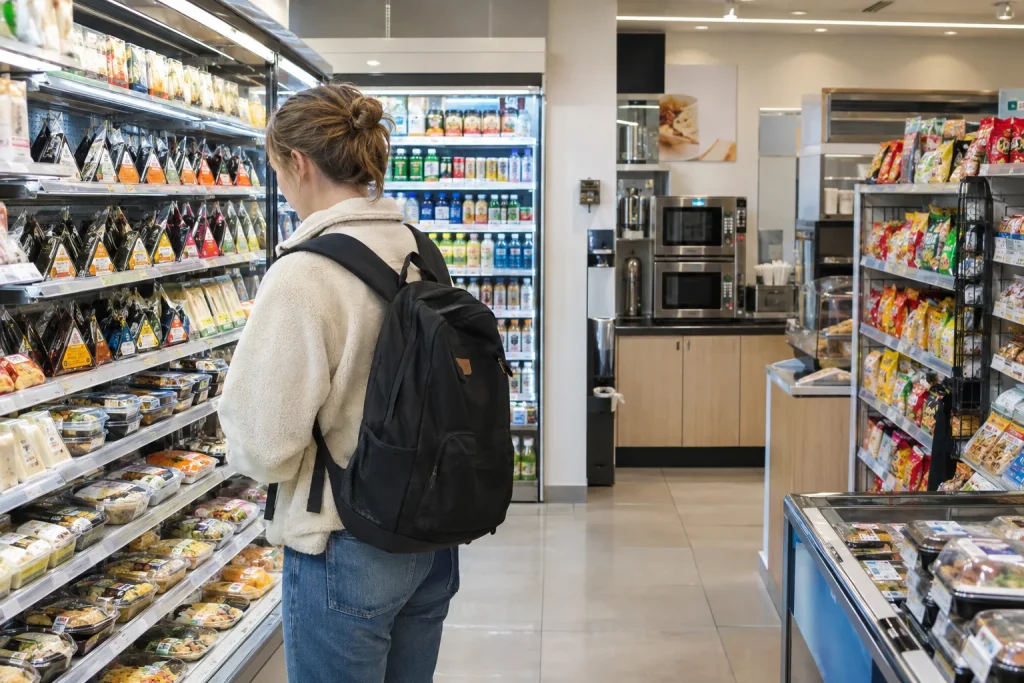
Korean convenience stores for foreigners are much more useful than a place to buy bottled water and snacks. During a trip to South Korea, a convenience store can become a quick stop for meals, drinks, transportation-card services, basic travel supplies and sometimes even SIM cards.
Major chains such as CU, GS25, 7-Eleven and Emart24 are easy to find in cities, around subway stations and near many tourist areas.
The stores are simple to use, but a few things can be confusing the first time: heating food, using self-service equipment, paying with a foreign card, understanding promotions and knowing which services vary by branch.
This guide explains the practical basics.
Korean convenience stores for foreigners: the quick guide
For most visitors, the basic process is straightforward:
- Choose your products.
- Take them to the counter or self-checkout if available.
- Pay.
- Ask whether food needs heating.
- Use the microwave or food-preparation area if the store provides one.
- Dispose of packaging correctly after eating.
You generally do not need a Korean account or Korean phone number simply to make an ordinary purchase.
Which convenience store chains will you see?
The major convenience-store brands in South Korea include CU, GS25, 7-Eleven and Emart24.
Travelers often encounter several different chains within a short walk, especially in busy neighborhoods.
The exact products and services vary by branch, so it is better to think of convenience stores as a category rather than assume every location offers exactly the same things.
Many convenience stores stay open very late
One reason Korean convenience stores are useful to travelers is their long operating hours.
Many locations operate around the clock, although this should not be assumed for every individual branch.
They can be especially useful after restaurants, cafés or shops near your accommodation have closed.
What can you buy?
Typical products include:
- Bottled water and soft drinks
- Coffee and energy drinks
- Snacks and desserts
- Instant noodles
- Triangle gimbap
- Lunch boxes
- Sandwiches
- Ready-to-eat meals
- Basic toiletries
- Umbrellas
- Charging cables and small accessories at some stores
Selection differs by location and chain.
Convenience-store food is part of Korean everyday culture
Korean convenience stores are well known for ready-to-eat food.
The Korea Tourism Organization highlights convenience stores as part of contemporary Korean food culture, including instant noodles, triangle gimbap, snacks, desserts and limited-edition products.
For a traveler, this makes them useful for a quick breakfast, late-night meal or inexpensive snack.
How do you heat convenience-store meals?
Many prepared meals are designed to be warmed in a microwave.
Some stores provide customer-use microwaves near the counter or eating area.
Packaging may include Korean heating instructions and a recommended time.
If you are unsure, show the product to the staff member and ask for help rather than guessing.
Be careful before putting packaging in a microwave
Do not assume every container or wrapper is microwave-safe.
Remove packaging or components when instructed and follow the directions printed on the product.
If you cannot understand the instructions, camera translation is useful.
How does instant ramyeon work?
Cup noodles are one of the easiest convenience-store meals.
Some stores provide hot-water dispensers, while selected locations have special self-service ramyeon cooking equipment.
The exact setup varies by store.
If you do not recognize the machine, watch the instructions carefully or ask the staff instead of experimenting with unfamiliar equipment.
Can you eat inside the convenience store?
Some convenience stores provide tables, counters or small seating areas.
Others have no customer seating at all.
A few larger or specially designed branches have extensive dining areas, while small neighborhood stores may have almost none.
Look for an obvious seating area rather than assuming food purchased there can always be eaten inside.
What happens to the trash?
If the store provides an eating space, it may also provide separate bins for different types of waste.
Follow the labels and pictures on the bins.
Do not leave used containers, drink cups or food waste on the table unless the store clearly instructs customers to do so.
Can you pay with an overseas credit card?
Card payment is common in South Korea and many foreign-issued international cards work for ordinary convenience-store purchases.
However, no traveler should assume that every overseas card will work at every payment terminal.
If a card is declined, try another card or another payment method rather than repeatedly attempting the same transaction.
Do you need cash?
Most everyday purchases can often be paid by card, but carrying some Korean won remains useful.
Cash may still be needed for particular transportation-card transactions, older equipment or situations where an overseas card is not accepted.
For travelers, a backup payment method is more useful than relying exclusively on either cash or one credit card.
What are the 1+1 and 2+1 signs?
Korean convenience stores frequently run multi-buy promotions.
You may see:
- 1+1 — buy one eligible item and receive one additional eligible item
- 2+1 — buy two eligible items and receive one additional eligible item
The promotion applies only to designated products during the promotional period.
Do not assume every product beside the sign is included; check the shelf label carefully.
Some promotions may depend on an app or membership
Not every displayed benefit is automatically available to every shopper.
Certain discounts, points or special offers may require a chain’s membership program, Korean app or specific payment method.
Foreign visitors do not need to sign up for these systems simply to make an ordinary purchase.
Can convenience stores recharge a transportation card?
Convenience stores are commonly used for transportation-card services.
According to official Korean tourism information, convenience stores are among the places where travelers can deal with transportation cards.
However, the exact card, transaction and accepted payment method can vary.
If you need to recharge a T-money or other transportation card, show the card to the cashier and state the amount you want to add.
Keep Korean won available for transportation cards
Transportation-card charging rules are not always the same as ordinary retail purchases.
A store may accept your foreign credit card for food but require a different payment method for adding value to a transportation card.
For this reason, keeping a small amount of cash can still be useful.
Can you buy a SIM card at a convenience store?
Some convenience stores sell physical prepaid SIM products.
VISITKOREA lists major convenience-store chains among SIM retail locations.
Availability varies by branch, so do not assume the nearest store will have the exact SIM package you need.
Travelers who need guaranteed connectivity immediately after arrival may find an airport telecom counter or advance online purchase more predictable.
Can tourists get a tax refund at a convenience store?
Some convenience-store locations and programs provide immediate tax-refund services for eligible foreign visitors.
This does not mean that every purchase at every Korean convenience store automatically qualifies.
Eligibility, participating locations, purchase requirements and identification procedures can change.
If tax refund is important for a particular purchase, check the current store signage or official service information before paying.
What about ATMs?
Many convenience stores contain ATMs, but international-card compatibility varies by machine and network.
An ATM being located inside a convenience store does not guarantee that it will accept your overseas card.
Look for international card-network logos or an English-language option.
Do convenience stores provide parcel services?
Korean convenience stores frequently offer parcel and delivery-related services for local customers.
For short-term foreign visitors, these services can be less straightforward because individual systems may require Korean addresses, phone numbers, apps or local account information.
Do not assume that every domestic convenience-store service is equally easy for a tourist to use.
Do you need to speak Korean?
Usually, very little Korean is required for a simple purchase.
Product prices are scanned at the register and card payments require minimal conversation.
For more complicated requests, a translation app can help.
Useful situations for camera or text translation include:
- Heating instructions
- Promotional labels
- Food ingredients
- Transportation-card questions
- SIM information
Check food ingredients carefully if you have allergies
Convenience-store food often has detailed ingredient information printed on the packaging, but much of it may be in Korean.
If you have a serious food allergy, do not make a safety decision only from the picture on the front of the package.
Translate the ingredient information and seek additional confirmation when necessary.
Self-checkout varies by store
Some shops have self-checkout equipment while others rely completely on staffed registers.
Interfaces and foreign-language support differ.
If the self-checkout is difficult to understand or your payment fails, simply use the staffed counter when available.
A practical convenience-store routine for tourists
For a simple visit:
- Choose what you need.
- Check any promotion labels.
- Pay at the register.
- Keep the receipt until the transaction is clearly complete.
- Ask before heating food if you are unsure.
- Use the designated eating area if available.
- Separate your waste according to the store’s bins.
After a few visits, Korean convenience stores become extremely easy to use.
Common mistakes foreign visitors make
- Assuming all branches provide exactly the same services
- Thinking every 1+1 sign applies to nearby products
- Assuming a foreign credit card will work for every type of transaction
- Putting unsuitable packaging into a microwave
- Assuming every store has seating
- Throwing different types of waste into the wrong bin
- Expecting every store to stock tourist SIM cards
- Assuming every branch offers tax refunds
Korean convenience stores for foreigners are genuinely useful
For international visitors, convenience stores can solve many small travel problems.
You can grab breakfast before sightseeing, find a late-night drink, buy a quick meal, look for basic travel supplies, deal with some transportation-card needs and sometimes purchase a SIM card.
The key is remembering that individual branches differ.
Related BestSpot Guides
- cash or card in South Korea
- how T-money works for visitors to South Korea
- Korean SIM card vs eSIM for travelers
Bottom line
Korean convenience stores for foreigners are one of the easiest parts of everyday travel in South Korea once you understand how they work.
Use them for food, drinks and basic supplies, and remember that some locations can also help with transportation cards, SIM products and other travel needs.
Pay attention to branch-specific services, keep a backup payment method available, and use translation when product instructions are unclear.
Sources
- VISITKOREA — Keeping Up with the Convenience Stores in Korea
- VISITKOREA — Electricity & Communications / SIM Card Information
- VISITKOREA — Tourist-Friendly Korea
Updated: October 2026. Store hours, products, payment methods and available services vary by convenience-store branch.