Korean apartment building numbers can look confusing to international visitors because a single apartment address may contain a road address, an apartment complex name, a building number, a floor, and a unit number.
But the system is actually quite logical once you understand the difference between the apartment complex itself and the specific home inside that complex.
The key words are 동 for the apartment building and 호 for the individual unit.
Korean apartment building numbers: the quick answer
A Korean apartment complex can contain many separate residential buildings.
Each building is usually identified by a building number written with the Korean suffix 동.
Inside that building, each apartment is identified by a unit number followed by 호.
For example:
505동 1402호
means:
- 505동 — Building 505
- 1402호 — Unit 1402
In many apartment buildings, Unit 1402 is located on the 14th floor, but travelers should not assume that every building follows exactly the same numbering convention.
What does 동 mean in a Korean apartment?
In an apartment address, 동 identifies a particular building or block inside the apartment complex.
A large Korean apartment development may contain buildings such as:
- 101동
- 102동
- 103동
- 104동
or:
- 501동
- 502동
- 503동
- 504동
The number tells you which physical apartment building you need to enter.
What does 호 mean?
호 identifies the individual unit, apartment, office, or room inside a building.
Examples include:
- 101호
- 502호
- 1001호
- 1402호
- 2304호
In residential apartment buildings, the unit number often contains information related to the floor.
How apartment unit numbers often relate to floors
A common Korean apartment numbering pattern uses the first digits of the unit number to indicate the floor.
For example:
- 302호 may be on the 3rd floor
- 705호 may be on the 7th floor
- 1203호 may be on the 12th floor
- 1802호 may be on the 18th floor
The final digits can identify the particular apartment on that floor.
However, numbering practices can vary between buildings, so the building’s actual signs and elevator information should always take priority.
Why Korean apartment addresses need both building and unit numbers
Large Korean apartment developments can function almost like small neighborhoods.
One road-name address may cover an entire apartment complex containing many separate residential towers.
The main road address brings you to the complex.
The building number identifies the correct tower.
The unit number identifies the correct home inside that tower.
This is why entering only the road address is often not enough for a delivery or visitor.
A typical Korean apartment address
Korea’s official Road Name Address Information System provides apartment examples in this general format:
Road-name address, Building 505, Unit 1402 (Apartment complex name)
In Korean, the detailed portion may appear as:
505동 1402호
The official system treats building, floor, and unit information as part of the detailed address.
The apartment complex name is different from the building number
This is an important distinction.
An apartment complex may have a name such as:
- Somewhere Apartments
- Somewhere Village
- Somewhere Xi
- Somewhere Prugio
- Somewhere Raemian
That name identifies the development.
The building number tells you which tower inside the development contains the destination.
So:
Apartment complex name + 103동
means “Building 103 inside this apartment complex.”
Why building numbers can start with 101
Many Korean apartment complexes use building numbers beginning with 101, 102, 103, and so on.
Other developments may use 201, 301, 501, or different numbering ranges.
The number should not automatically be interpreted as a floor number.
101동 means Building 101, not the 101st floor.
Do Korean apartment building numbers have a universal national pattern?
No single numbering sequence applies to every apartment complex.
The official Korean address system provides general guidance for assigning detailed building information, but the actual arrangement of apartment buildings depends on the individual development.
Korea’s address guidance recommends assigning building numbers in a logical sequence based on the main entrance and layout of the complex.
Still, visitors should rely on the signs at the actual complex rather than trying to predict the physical location from the building number alone.
Why Building 101 may not be next to Building 102
Numbers can provide a logical organizational system, but apartment-complex layouts are influenced by:
- Roads
- Parking areas
- Parks
- Schools
- Slopes
- Construction phases
- Building orientation
So Building 101 and Building 102 may not always appear exactly where an unfamiliar visitor expects.
Look for complex maps or building-number signs near the entrance.
Apartment complexes often have maps at the entrance
Large complexes commonly display a site map showing the locations of individual buildings.
This can be extremely useful for:
- Visitors
- Taxi drivers
- Food-delivery riders
- Parcel couriers
- Moving companies
If you enter the wrong gate, checking the site map can save a long walk through the complex.
What does 층 mean?
층 means floor.
For example:
- 1층 — first floor
- 5층 — fifth floor
- 14층 — fourteenth floor
Korea’s official detailed-address guidance treats floor information separately from the building and unit number.
In a typical apartment address, however, the unit number may already make the floor obvious.
Underground floors use 지하
지하 means underground or basement.
You may see:
- 지하 1층 — basement level 1
- 지하 2층 — basement level 2
Apartment parking garages commonly use underground levels.
Visitors arriving by car may therefore need both the apartment building number and the correct underground parking area.
Why parking garages make apartment navigation more complicated
Large complexes often have shared underground parking garages connecting several apartment buildings.
A driver can enter the correct complex but park beneath the wrong building.
Look for signs showing the building number, such as:
103동
before taking the elevator upstairs.
The elevator usually confirms the building and floor
Once inside the correct building, elevator signs are useful confirmation.
The elevator panel normally lists available floors.
Lobby signage may also show the building number and sometimes the unit ranges served by different entrances or elevator banks.
If the building contains multiple entrances, make sure you are using the entrance that serves your destination unit.
Some buildings have more than one entrance
Large residential towers can have multiple entrances or elevator areas.
This means arriving at the correct building does not always mean you are standing at the best entrance for the destination unit.
Check signs around the lobby for unit-number ranges.
For example, one entrance may primarily serve one group of apartments while another entrance serves different units.
Why delivery apps ask for detailed apartment information
A map app only needs to guide someone to the apartment complex or building.
A delivery service needs enough information to reach the customer’s actual door.
That is why a Korean delivery address can include:
- Road-name address
- Apartment complex name
- Building number
- Unit number
- Entrance instructions
- Lobby or security instructions
What a delivery rider really needs
Imagine a complex with 15 apartment towers.
If the customer enters only the road-name address, the rider may reach the correct complex but still have no idea which building contains the customer.
Adding:
105동 1203호
provides the missing destination.
Apartment security can add another step
Many Korean apartment buildings have controlled entrances.
A visitor may encounter:
- Lobby intercom
- Digital door access
- Security office
- Resident call system
- Restricted elevator access
Knowing the building and unit number is therefore necessary even before reaching the apartment door.
What should a visitor tell the security desk?
If you need assistance entering an apartment complex, the most useful information is usually:
- Resident’s name if known
- Building number
- Unit number
Showing the Korean version of the address can also reduce misunderstandings.
Why Korean apartment names can be confusing
Many apartment developments use similar brand names.
The same apartment brand may have multiple complexes in the same district.
Do not rely only on the apartment name.
The road address and exact building number are much safer identifiers.
A taxi driver may need more than the apartment name
For a large complex, it can help to provide:
- Road-name address
- Apartment complex name
- Building number
The driver may be able to choose a gate closer to the destination building if that information is available.
Why the nearest gate matters
Some Korean apartment developments are very large.
Entering through the wrong gate can leave you several hundred meters from the correct building.
If you are carrying luggage or meeting someone, ask which gate or entrance is closest to the destination building.
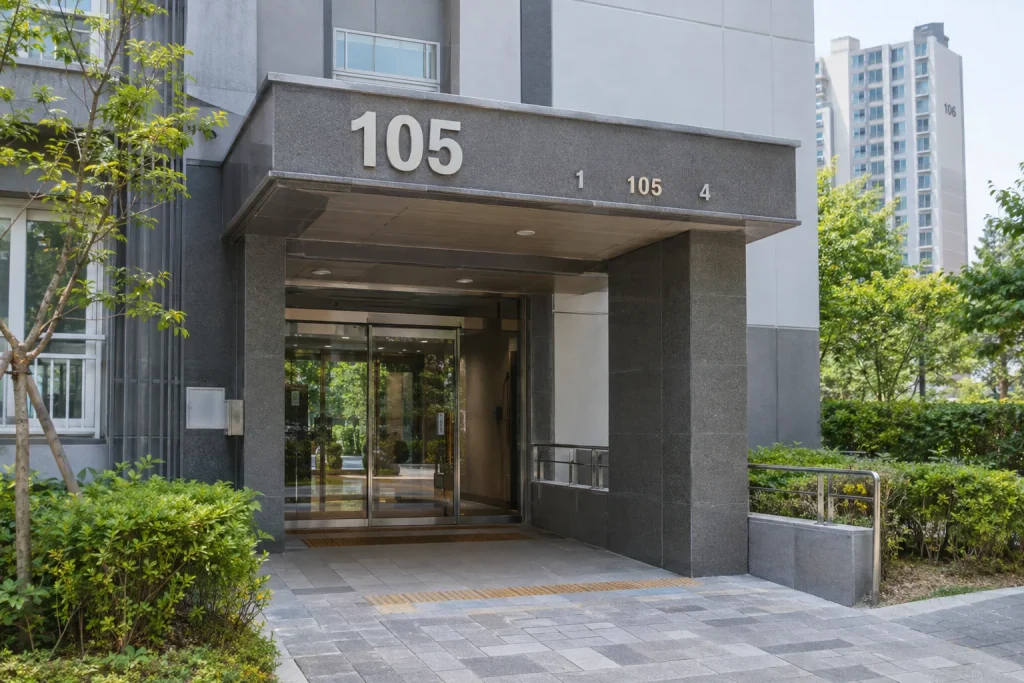
Building numbers are visible from outside
Korean apartment towers usually display their building number prominently on the exterior.
You may see large numbers such as:
101
or:
101동
high on the side of the tower or near the entrance.
This makes visual identification relatively easy once you are inside the correct complex.
Why numbers are often large and easy to see
Building identification is important not only for residents and visitors but also for emergency services, deliveries, maintenance, and transportation.
Large exterior numbers make it possible to identify the correct tower from a distance.
Unit numbers are usually displayed near the apartment door
After reaching the correct floor, individual apartment entrances normally display the unit number.
Check that the number matches before ringing the doorbell or using the intercom.
In buildings with similar floor layouts, it is easy to approach the wrong door if you are distracted.
What if a unit number appears to skip?
Not every floor necessarily contains the same number of units.
Some layouts contain:
- Two apartments per floor
- Three apartments per floor
- Four or more apartments per floor
- Different unit arrangements on lower or upper floors
Do not assume a missing number indicates a mistake.
Why some unit numbers avoid certain numbers
Individual buildings can have their own numbering practices.
Some may skip particular room numbers or floors for cultural, architectural, or operational reasons.
The actual signs in the building are always more reliable than guessing from the numbering pattern.
Korean apartment building numbers and English addresses
When writing an apartment address in English, the detailed building and unit information can still be included.
Korea’s official road-name address system provides English address information while maintaining the detailed destination information needed to identify the residence.
For international shipping, use the exact English address generated by an official address lookup whenever possible.
What should you save before visiting a Korean apartment?
Keep:
- Road-name address
- Apartment complex name
- Building number
- Unit number
- Resident phone number if appropriate
- Gate or entrance instructions if available
This is much more useful than saving only the complex name.
A practical example
Suppose your destination includes:
Apartment Complex A, 505동 1402호
Your navigation process is:
- Use the road address to reach Apartment Complex A.
- Find Building 505 inside the complex.
- Enter Building 505.
- Go to the 14th floor if the building’s numbering confirms that layout.
- Find Unit 1402.
The road address, building number, and unit number each solve a different part of the navigation problem.
Common mistakes foreign visitors make
Typical mistakes include:
- Thinking 101동 means the 101st floor
- Entering only the apartment-complex name in a taxi app
- Forgetting the unit number for a delivery
- Going to the right complex but the wrong building
- Parking under the wrong apartment tower
- Confusing a building number with a unit number
Korean apartment building numbers become easy once you separate the layers
The address works in layers:
Road address → apartment complex → building → floor → unit.
You do not need to memorize the entire Korean address system at once.
Simply identify which layer of information you need at each step.
Bottom line
Korean apartment building numbers identify the individual residential towers inside an apartment complex, while unit numbers identify the specific home inside the building.
In an address such as 505동 1402호, 505 is the apartment building and 1402 is the unit.
For navigation, delivery, taxis, and visiting residents, keep the road address, apartment-complex name, building number, and unit number together.
Once you separate those pieces, even very large Korean apartment complexes become much easier to understand.
Related BestSpot Guides
- how Korean addresses work in maps and delivery apps
- using Korean taxis without speaking Korean
- Naver Map vs KakaoMap vs Google Maps in Korea
Sources
- Road Name Address Information System — Address and Detailed Address Structure
- Road Name Address Information System — Apartment Address Formatting Examples
- Road Name Address Information System — Detailed Address Data
- Ministry of the Interior and Safety — Detailed Address System
Updated: September 2026. Individual apartment layouts, building numbering, entrances, security procedures, and detailed-address formats can vary by development.