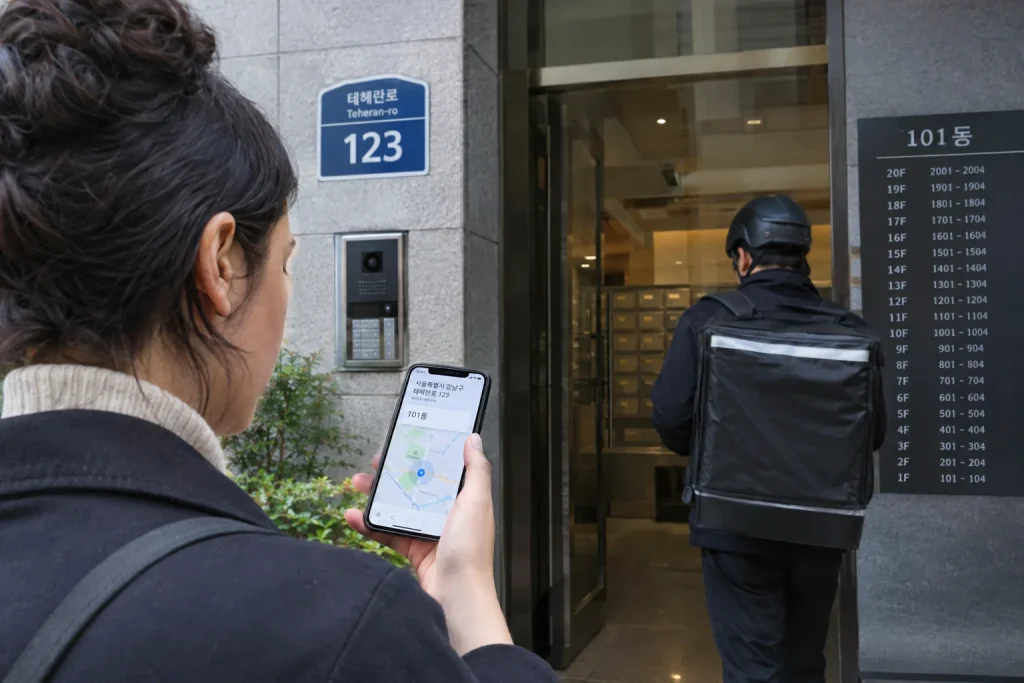
How Korean addresses work can be confusing at first, especially when using maps, delivery apps, taxis, or online shopping in South Korea.
Visitors may see a road-name address, an older land-lot address, a building name, an apartment name, a neighborhood name, and sometimes a detailed unit number all referring to the same place.
The good news is that Korea’s current road-name address system follows a clear structure once you understand the basic rules.
How Korean addresses work in everyday life
South Korea uses a road-name address system built around the road name and building number.
According to Korea’s official Road Name Address Information System, a standard road-name address can include:
- Province or metropolitan city
- City, district, or county
- Township when applicable
- Road name
- Building number
- Detailed address such as building, floor, or unit number
A simplified example looks like this:
Seoul, Gangnam-gu, Gangnam-daero 123
An apartment or office may then add a building, floor, or unit number after the main address.
Why Korea has two address styles
Visitors often encounter both a road-name address and a land-lot address.
The older land-lot system is based on parcels of land, while the road-name system is based on roads and buildings.
The official Korean address system describes the road-name address as a building-centered system designed to make locations easier to identify and navigate.
This is why a map app may show both formats for the same destination.
Road name plus building number
The most important part of a modern Korean address is the road name and building number.
The official address system assigns names to roads and numbers to buildings according to their position along the road.
Building numbers are generally assigned from the starting point of the road, with odd numbers on one side and even numbers on the other.
This makes the numbering system useful for estimating where a building is located along a street.
What daero, ro, and gil mean
Korean road names often end with one of several common suffixes.
- -daero generally refers to a major road or boulevard
- -ro refers to a road
- -gil refers to a smaller street or side road
You may also see forms such as -beon-gil, which identifies a branch or numbered side street.
For example, an address such as Gangnam-daero 10-gil identifies a smaller road connected to Gangnam-daero.
Why Korean map apps sometimes show more than one address
Local map services may display several location identifiers because Koreans still encounter older and newer address forms in daily life.
A business listing may include:
- Road-name address
- Land-lot address
- Building name
- Neighborhood name
- Floor or unit information
For travelers, the road-name address is usually the most useful starting point for navigation.
How Korean addresses work in map apps
When searching in NAVER Map or KakaoMap, you do not always need to type the entire formal address.
You can often search using:
- Business name
- Building name
- Road-name address
- Land-lot address
- Nearby landmark
Korea’s official Road Name Address Information System also supports searches by road name, building name, and land-lot number.
For more on local navigation, see our guide to Naver Map vs KakaoMap vs Google Maps in Korea.
Why the Korean name can be more useful than the English name
One of the most practical habits for visitors is keeping the Korean version of an address or place name.
English transliterations can vary, while the Korean name is usually the exact form used in domestic map and delivery databases.
If a place is difficult to find, copying the Korean address directly into a local map app can often work better than retyping an English version.
How delivery apps use Korean addresses
Delivery services need more detail than a map app because the courier has to reach the correct entrance, building, floor, or apartment unit.
A delivery address may therefore include:
- Road-name address
- Building or apartment name
- Building number
- Floor
- Unit number
- Entrance or gate instructions
- Delivery notes
This is especially important in large apartment complexes, office towers, university campuses, and mixed-use buildings.
Why apartment addresses can look complicated
Korean apartment complexes can contain many separate buildings inside one development.
The official address may identify the main road location, while the detailed address specifies the exact apartment building and unit.
For example, a delivery driver may need both the road-name address and something like:
Building 505, Unit 1402
The official address system treats building, floor, and unit information as part of the detailed address.
Building names matter more than visitors expect
Many Korean locations are commonly identified by building name as well as formal address.
Large office towers, shopping complexes, apartments, hotels, hospitals, and universities may be easier to recognize by building name than by street number alone.
This is why keeping both the address and building name can be useful.
What to send to a taxi driver
If you are taking a taxi, the simplest option is often to show the destination directly in a Korean map app.
A map pin or Korean place name reduces the risk of confusion caused by pronunciation or romanization.
If you need to provide an address manually, use the road-name address and, when useful, the building name.
What to enter into a delivery app
When a Korean delivery or shopping app asks for an address, the process often has two stages.
- Search for the main road-name address or building.
- Add the detailed address such as apartment building, floor, or unit.
If delivery repeatedly fails, check whether the detailed address or entrance information is missing.
Why maps and delivery apps can behave differently
A map app only needs to guide you to a location.
A delivery app needs to identify the exact destination inside that location.
This is why a map search may succeed with only a building name while a delivery app asks for additional information.
How English Korean addresses are written
Korea’s official address guidance recommends writing English addresses from smaller unit to larger unit.
A Korean road-name address such as:
서울특별시 강남구 강남대로10길 109
can be written in English as:
109 Gangnam-daero 10-gil, Gangnam-gu, Seoul
The official system also provides an English address search service for road-name addresses.
What about postal codes?
Korean addresses are also associated with postal codes, which are commonly required for shipping, online shopping, and international mail.
If you are unsure of the correct address or postal code, the official Road Name Address Information System can be used to search and verify the location.
Common mistakes foreign visitors make
A few mistakes appear repeatedly.
- Using only an English business name when the local database uses Korean
- Entering the building name but forgetting the unit number
- Confusing the road-name address with the land-lot address
- Typing spaces incorrectly inside Korean road names
- Assuming an international map listing uses the same format as a Korean delivery app
A practical address workflow for travelers
For important destinations, keep four pieces of information:
- English place name
- Korean place name
- Road-name address
- Map pin or saved location
For a hotel or accommodation, also keep the Korean phone number if available.
This combination works well for maps, taxis, deliveries, and asking local staff for help.
Why Korean addresses feel complicated at first
The system itself is not especially complicated. The confusion comes from seeing several valid ways to refer to the same place.
Visitors may encounter a modern road-name address, an older land-lot address, a building name, a neighborhood name, and detailed unit information all at once.
Once you recognize the road-name address as the main location and the detailed address as the final destination inside the building, the structure becomes much easier to understand.
Bottom line
How Korean addresses work becomes much clearer when you separate the main road-name address from the detailed building information.
For navigation, the road name and building number are usually enough. For delivery, apartments, offices, and large complexes, you may also need a building, floor, unit, or entrance instruction.
Keep the Korean version of important addresses whenever possible, and use local map apps when an English search does not return the result you expect.
Related BestSpot Guides
Sources
- Road Name Address Information System — How Korean Road-Name Addresses Work
- Road Name Address Information System — English Address Search
- Ministry of the Interior and Safety — English Road-Name Address Guidance
Updated: September 2026. Address databases, app interfaces, and delivery requirements can change depending on the service.