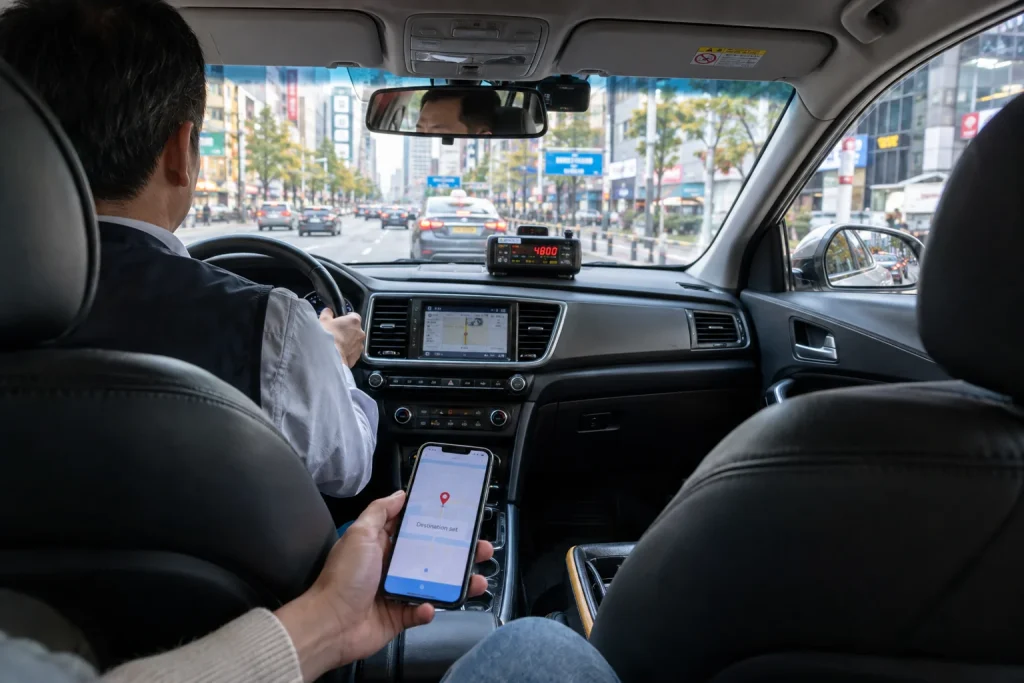
Korean taxis without speaking Korean are much easier to use than many first-time visitors expect.
You do not need to memorize Korean addresses, explain every destination verbally, or negotiate a route with the driver.
With the right taxi app, a saved destination, and a few simple habits, most international visitors can use Korean taxis with very little spoken Korean.
Korean taxis without speaking Korean: the quick answer
The easiest approach is to use a taxi-hailing app that lets you enter the destination before the ride begins.
When the app sends the destination directly to the driver, you usually do not need to explain where you are going.
For international visitors, traveler-friendly services such as k.ride or Uber Taxi can reduce language and payment problems.
Why taxi apps solve most language problems
When you hail a taxi on the street, communication starts immediately.
You need to explain the destination, confirm that the driver understood it, and sometimes clarify a building entrance or neighborhood.
A taxi app changes that process.
The destination is entered digitally before the ride starts, and the driver receives the trip information through the dispatch system.
Seoul Metropolitan Government specifically notes that when using a taxi app, passengers do not need to tell the driver their destination again after boarding.
Use the exact destination, not only the neighborhood
Instead of entering a general area such as “Gangnam” or “Hongdae,” search for the exact hotel, restaurant, station, or building whenever possible.
This reduces confusion and gives the driver a more precise arrival point.
For hotels, keep the Korean name and address available in case the app search produces several similar results.
Why Korean place names are useful
English spellings of Korean places can vary.
A hotel or restaurant may be listed under one English transliteration in an international app and another spelling in a Korean database.
Keeping the Korean place name allows you to:
- Search more accurately
- Show the driver the destination if needed
- Confirm the correct building
- Avoid pronunciation problems
k.ride is designed for international visitors
k.ride is operated by Kakao Mobility and is specifically designed for users traveling outside their home country.
The service supports English, Japanese, Simplified Chinese, and Traditional Chinese interfaces.
Kakao Mobility also states that destination search and driver-passenger chat support more than 100 languages.
This makes the app particularly useful for travelers who do not speak Korean.
k.ride can reduce payment barriers
One reason foreign visitors struggle with some domestic mobility apps is payment setup.
VISITKOREA explains that k.ride allows overseas credit cards to be registered as a payment method.
It also supports social login options such as Google or Apple, making registration easier for non-residents.
Uber Taxi also works in Korea
Visitors who already use Uber may prefer to continue using the same app in Korea.
VISITKOREA states that Uber Taxi is available in Korea and that users can use their existing app and stored payment information.
The service also provides automatic message translation to help communication between passengers and drivers.
Which taxi app should a visitor use?
There is no single mandatory choice.
k.ride is useful if you want a service specifically designed for international users in Korea.
Uber Taxi is convenient if you already use Uber and want to keep the same account and payment setup.
The most important thing is choosing a service that supports your language and payment method.
Enter the destination before requesting the taxi
Do not request a taxi first and try to explain the destination afterward.
Search and confirm the destination carefully before tapping the final request button.
Check:
- Business or hotel name
- Address
- Map pin
- Pickup point
- Destination entrance if relevant
Check the pickup point carefully
In dense Korean neighborhoods, the pickup point can matter as much as the destination.
A taxi may not be able to stop exactly where you are standing because of:
- Bus-only lanes
- Large intersections
- One-way streets
- Building access restrictions
- Underground roads
- Taxi stopping restrictions
Look at the app map and walk to the exact pickup point when needed.
Large hotels and stations can have multiple pickup areas
A major railway station, airport terminal, shopping complex, or hotel can have several entrances.
If the app assigns a specific gate, exit, or pickup zone, follow that location rather than waiting at another entrance.
This prevents the common problem of seeing your taxi nearby but being physically separated from it by a large building or road.
Always check the license plate before boarding
Seoul Metropolitan Government advises taxi-app users to confirm that the taxi’s license plate matches the vehicle assigned in the app.
This is especially useful in busy pickup areas where several similar taxis may arrive at the same time.
Check the plate number before opening the door.
Do not identify the taxi only by color
Many Seoul taxis share similar colors and vehicle types.
A vehicle’s color is not enough to confirm that it is your assigned taxi.
The license plate and app information are much more reliable.
What if the driver calls you?
Drivers sometimes call when they cannot find the passenger or when the pickup point is unclear.
If you do not speak Korean, the easiest response may be to use the app’s chat feature or translation function rather than trying to have a complicated phone conversation.
When possible, send a short translated message such as:
“I am waiting at the main entrance.”
or
“I am standing near Exit 3.”
Use landmarks when the exact pickup point is confusing
If you need to clarify your location, a simple landmark can help.
Examples include:
- Subway Exit 4
- Hotel lobby entrance
- Convenience store entrance
- Main gate
- Airport terminal door number
Short, concrete location descriptions translate better than long explanations.
Keep the hotel name in Korean
This is one of the most useful habits for visitors.
Save your accommodation name and address in Korean as soon as you check in.
If an app fails, your phone battery is low, or you hail a taxi directly from the street, showing the Korean hotel name can solve the language problem immediately.
Can you hail a taxi from the street?
Yes.
Traditional street hailing is still common in Korea.
However, a taxi app is usually easier for international visitors because the destination, expected fare, vehicle information, and payment options can be handled digitally.
Street hailing is most useful when a taxi is immediately available and the destination is easy to show.
What should you show a street-hail taxi driver?
If you enter a taxi without using an app, show the destination in Korean on your phone.
A map pin or Korean address is more reliable than trying to pronounce a long Korean place name.
You can also show a hotel business card if your accommodation provides one.
Do taxi drivers speak English?
Some do, but you should not assume that every driver will.
This is not usually a problem because modern taxi apps remove most of the need for spoken directions.
For travelers who specifically want multilingual assistance, Seoul also offers international taxis with multilingual drivers.
What are international taxis?
Seoul operates international taxi services aimed at foreign visitors.
The city describes these taxis as having multilingual drivers and offering services such as airport pickup, drop-off, sightseeing, and business transportation.
They generally cost more than ordinary taxis and are best suited to travelers who value language support or prearranged service.
International taxis are useful for airport pickup
A prebooked multilingual taxi can be especially convenient after a long flight.
It removes the need to find a taxi stand, explain the hotel destination, and manage payment while tired or carrying luggage.
Advance reservation is usually required for international taxi services.
What should you know about taxi fares?
Taxi fares are generally meter-based unless a specific app or special taxi service provides another fare structure.
A taxi-hailing app may show an expected fare before booking.
Seoul Metropolitan Government notes that estimated fares in taxi apps can help tourists plan transportation expenses.
The final fare can still vary depending on traffic, route, tolls, and other applicable charges.
Late-night fares can be higher
Taxi pricing can include late-night surcharges depending on time and local rules.
If you are traveling late at night, expect that the fare may be higher than the same trip during the day.
Check the current fare information in the app or official local guidance when cost is important.
Tolls can be added to the fare
Routes using toll roads or airport expressways may include additional toll charges.
This is normal and separate from the distance/time portion of the taxi fare.
Airport journeys are a common example where tolls can appear.
Be careful not to pay twice
Seoul’s taxi guidance specifically warns passengers not to pay again if the fare has already been charged through the taxi app.
Before handing over cash or a physical card, check whether your selected payment method was:
- Automatic in-app payment
- Payment inside the taxi
- Cash payment
The exact options vary by app and booking.
Keep your payment method ready before the ride ends
If the ride is not prepaid in the app, prepare your card or cash before arrival.
This makes the exit smoother and reduces confusion at the destination.
Many Korean taxis accept cards, but a backup payment option is still useful.
What if you leave something in the taxi?
Using a taxi app can make lost-item recovery easier because you have a digital trip record.
Keep the ride history rather than deleting it immediately.
Useful information can include:
- Vehicle number
- Ride time
- Pickup location
- Destination
- Payment record
What if there is a dispute or problem?
Keep records.
Take screenshots of the trip information, vehicle number, fare, or relevant messages if something unusual happens.
Seoul provides complaint channels for taxi passengers, including options intended to help international visitors.
The Korea Travel Helpline 1330 can also assist travelers with tourism-related questions.
Should you use translation apps inside the taxi?
Yes, when necessary, but keep messages short.
Translation tools work best for simple statements such as:
- “Please stop here.”
- “This is the correct entrance.”
- “Please wait one minute.”
- “I will pay by card.”
Long explanations create more opportunities for mistranslation.
Screenshot important destinations before leaving Wi-Fi
If mobile data fails, a screenshot of the destination can still be shown to the driver.
For an important journey, save:
- Korean destination name
- Korean address
- Map screenshot
- Hotel phone number
This is especially useful for late-night rides or destinations outside major tourist areas.
A practical taxi routine for visitors
- Open your taxi app.
- Enter the exact destination.
- Check the pickup point.
- Choose your payment method.
- Request the taxi.
- Check the assigned license plate.
- Wait at the exact pickup point.
- Confirm the car before boarding.
- Let the app provide the destination.
- Check whether payment is automatic before paying again.
Korean taxis without speaking Korean are mostly a preparation problem
The language barrier becomes much smaller when the important information is already inside the app.
The driver needs a destination, the passenger needs the correct vehicle and pickup point, and both sides need a clear payment method.
Modern taxi apps can handle most of those steps before you ever open the car door.
Bottom line
Korean taxis without speaking Korean are straightforward when you use a traveler-friendly taxi app and enter the destination before requesting the ride.
Use the exact Korean destination when possible, confirm the pickup point, check the license plate before boarding, and know whether your fare is being paid automatically in the app.
For most visitors, these simple habits remove nearly all of the communication problems that once made taxi travel intimidating.
Related BestSpot Guides
- Papago vs Google Translate for Korean travel
- Naver Map vs KakaoMap vs Google Maps in Korea
- essential apps for South Korea travel
Sources
- Seoul Metropolitan Government — How to Use Seoul Taxis
- VISITKOREA — Taxi Guide for International Visitors
- Kakao Mobility — k.ride
- Kakao Mobility — k.ride Launch
Updated: September 2026. Taxi-app availability, payment options, fare rules, and language support can change. Check the current app and local taxi guidance before relying on a specific feature.