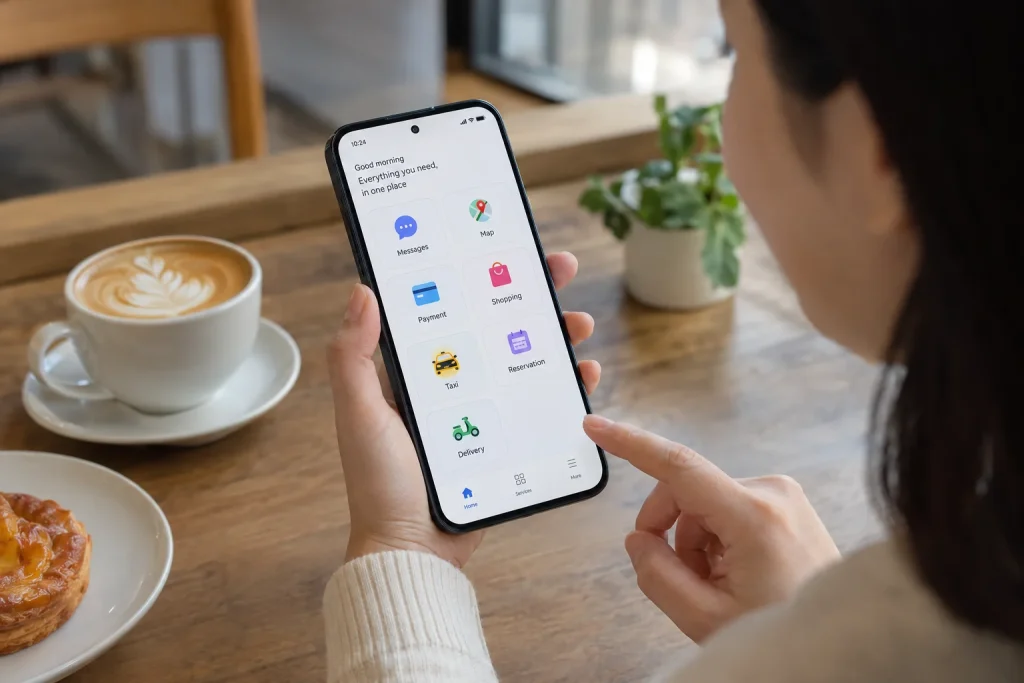
Korea’s super-app culture can be surprising for visitors who are used to using separate apps for messaging, maps, payments, shopping, taxis, reservations, and local search.
In South Korea, major digital platforms often connect several of those activities through one account and one broader ecosystem.
This does not mean that every Korean service is literally contained inside a single app. Instead, a few major platforms act as gateways that connect communication, search, payments, transportation, shopping, reservations, and local services.
What Korea’s super-app culture actually means
A super app is generally understood as a platform that provides access to many different digital services instead of focusing on only one task.
In Korea, this idea is most visible in the ecosystems built around Kakao and NAVER.
Users may start with messaging or search and then move into shopping, payments, maps, transportation, reservations, or other services without leaving the same broader account ecosystem.
KakaoTalk is more than a messaging app
KakaoTalk is best known as a messaging service, but the broader Kakao ecosystem extends far beyond chat.
Kakao’s official service portfolio includes:
- KakaoTalk
- Kakao Shopping
- Kakao Map
- Kakao T
- Kakao Pay
- Kakao Business
- Other content and lifestyle services
For many Korean users, KakaoTalk is therefore not just a place to send messages. It can also serve as a starting point for shopping, customer service, business communication, reservations, payments, and mobility.
KakaoTalk Channels connect chat with real-world actions
KakaoTalk Channels are a good example of Korea’s super-app culture.
Kakao’s official description says users can interact with businesses through chat and perform actions such as finding stores, tracking orders, making reservations, and placing orders.
Businesses can also send order information, payment history, and delivery updates through KakaoTalk.
This creates a very different experience from using a messaging app only for conversations.
Shopping is integrated into communication
KakaoTalk Gift is one of the most recognizable examples of this integration.
Users can send gifts directly through KakaoTalk without leaving the broader platform ecosystem.
Kakao’s Q2 2026 results show that commerce inside KakaoTalk remains a major part of the company’s platform business, including KakaoTalk Gift and Talk Deal.
This illustrates how communication and commerce can become closely connected inside a super-app ecosystem.
Kakao Pay adds payments to the same ecosystem
Kakao Pay extends the platform into financial and payment services.
Kakao describes Kakao Pay as supporting activities such as payments, money transfers, memberships, bills, and financial management.
From a user’s perspective, this means messaging, shopping, and payments can feel like parts of one connected digital environment rather than separate services.
Kakao T connects mobility services
Kakao T is another important part of the ecosystem.
Kakao describes Kakao T as a service that integrates multiple transportation options through a single interface and integrated search.
For users, that can include taxis and other mobility services depending on the region and service availability.
This is another example of the super-app model: a user does not necessarily need a different platform for every type of transportation.
NAVER follows a different super-app path
NAVER’s ecosystem developed from search rather than messaging.
But the result is similar in one important way: users can move from information to action without leaving the broader NAVER environment.
NAVER connects services such as:
- Search
- NAVER Map
- Shopping
- NAVER Pay
- Reservations
- Local business information
- Content and community services
Search can lead directly to maps and reservations
NAVER’s 2026 AI Tab illustrates this direction clearly.
NAVER says users can move from discovering places through AI search to checking maps and making real-time reservations.
This is a key characteristic of Korea’s super-app culture: information is often connected directly to the next action.
A restaurant search is not only a search result. It can lead to a map, reviews, reservation options, and sometimes payment-related services.
Why super apps developed so strongly in Korea
South Korea has a highly connected mobile environment and a population accustomed to using digital services for everyday tasks.
Major domestic platforms were able to expand from their original functions into additional services because users already had active accounts and frequent daily engagement.
Kakao expanded from messaging into commerce, payments, mobility, and business services.
NAVER expanded from search into maps, shopping, payments, reservations, content, and local discovery.
One account becomes more valuable over time
Super-app ecosystems become more useful as users connect more services to the same account.
A user who already has a Kakao Account may find it convenient to use KakaoTalk, Kakao T, Kakao Pay, and other related services.
A NAVER user may use the same account for maps, saved places, shopping, reservations, and payments.
This account-based integration is one reason NAVER and Kakao login buttons appear across many Korean services.
For more detail, see our guide to Naver and Kakao login in Korea.
Why super apps can feel complicated to visitors
Super apps can be extremely convenient for people who already live inside the ecosystem.
But international visitors may see the opposite side first.
A service may assume that the user already has:
- A local platform account
- A Korean mobile number
- Identity verification
- A supported payment method
- A Korean address
This can make an integrated service feel more complicated rather than more convenient.
Super apps and Korean identity verification
Some functions inside these ecosystems require stronger verification than simple account login.
A user may successfully log in with NAVER or Kakao but still encounter additional verification before using payments, reservations, or regulated services.
Our guide to Korean phone verification explains why this happens.
Super apps and payments
Payments are one of the areas where ecosystem integration is most visible.
When a domestic user already has a local payment method linked to the platform, checkout can be extremely fast.
Foreign visitors may have a different experience because some domestic payment flows were designed around Korean cards, accounts, or identity verification.
See our guide to why foreign credit cards fail in some Korean apps for a practical explanation.
Super apps also connect online and offline life
The most interesting part of Korea’s super-app culture is that it connects digital activity with real-world actions.
A user may:
- Search for a restaurant
- Check its location
- Read reviews
- Make a reservation
- Pay
- Get directions
- Receive follow-up messages
Those actions may happen across connected services within the same broader ecosystem.
Kakao is moving toward agentic AI inside KakaoTalk
In 2026, Kakao announced plans to introduce agentic AI experiences inside KakaoTalk.
The company says these experiences are intended to help users complete everyday tasks such as ordering, booking, and making payments.
Kakao also said it plans to work with partners across commerce, travel, reservations, and payment use cases.
This suggests that the super-app model is continuing to evolve from connected services toward systems that can help users complete tasks directly.
NAVER is also moving from search to action
NAVER’s AI Tab follows a similar pattern from the search side.
Instead of simply answering a question, NAVER increasingly connects search results to actions such as place discovery, mapping, and reservations.
The long-term direction is clear: platforms want users to move from asking what they should do to actually doing it within the same service environment.
Is Korea’s super-app culture good or bad?
It has both advantages and trade-offs.
The advantages include:
- Fewer separate accounts
- Fast movement between services
- Integrated payments
- Convenient local information
- Easy connection between online and offline activities
The trade-offs can include:
- More complex interfaces
- Greater dependence on a small number of platforms
- Account or verification requirements
- Difficulty for users outside the domestic ecosystem
Do visitors need to join every super-app ecosystem?
No.
Most short-term visitors only need a small number of local apps.
You do not need to recreate the full digital setup of a Korean resident during a one-week trip.
Start with navigation, translation, transportation, and payment tools that solve specific problems.
Our guide to essential apps for South Korea travel explains which ones are most useful.
Why understanding the ecosystem still helps
Even if you never use Kakao Pay or NAVER Pay, understanding Korea’s super-app culture explains many things visitors encounter.
It explains why:
- A messaging account appears on shopping websites
- A map app includes reservations
- A search engine connects to payments
- A taxi platform offers multiple mobility services
- A business sends order updates through a chat app
Bottom line
Korea’s super-app culture developed because major domestic platforms expanded far beyond their original functions.
Kakao connects messaging with commerce, payments, mobility, and business services. NAVER connects search with maps, shopping, payments, reservations, and local discovery.
For Korean residents, this integration can make everyday digital tasks extremely convenient.
For international visitors, understanding the ecosystem makes unfamiliar app behavior much easier to understand.
Sources
- Kakao — Service Ecosystem
- Kakao — KakaoTalk Channel
- Kakao — Kakao T
- Kakao — Q2 2026 Results and Agentic AI Strategy
- NAVER — AI Tab and Action-Oriented Search
Updated: September 2026. Platform features, integrations, account requirements, and AI capabilities can change over time.