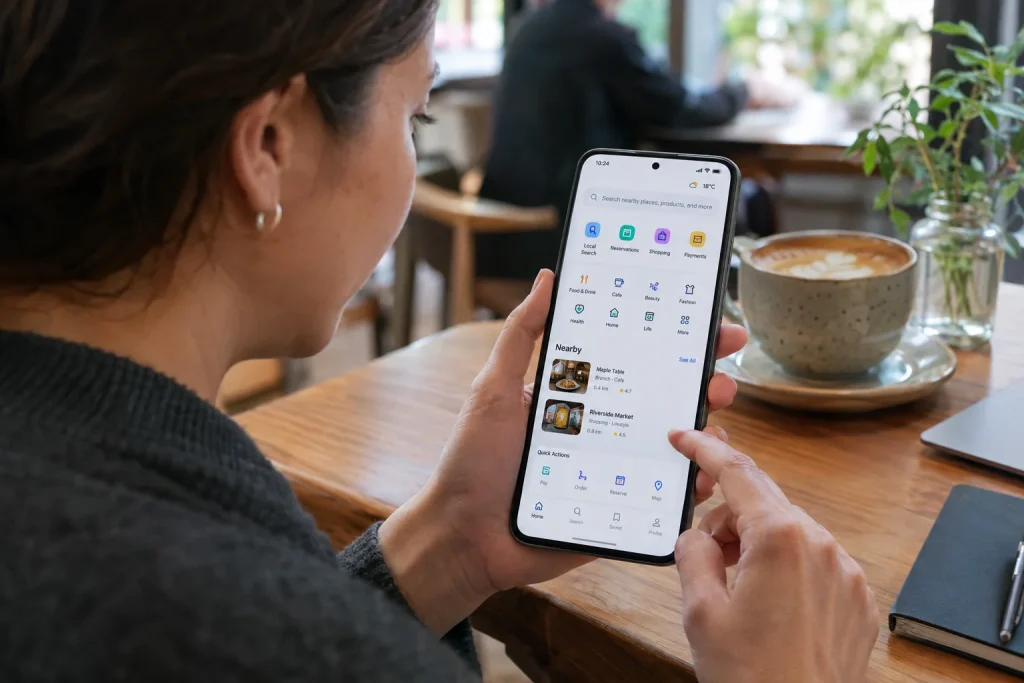
Why Korean apps feel so different is a question many international visitors ask soon after arriving in South Korea.
The difference is not just language. Korean apps often combine search, maps, payments, reservations, messaging, shopping, identity verification, and local services in ways that may feel denser or more interconnected than the apps many visitors use at home.
Once you understand the structure behind this ecosystem, Korean apps become much easier to navigate.
Why Korean apps feel so different at first
Many Western apps are designed around a relatively narrow core task. A map app handles navigation. A messaging app handles communication. A payment app handles payments.
In Korea, major platforms often connect multiple parts of daily life.
NAVER, for example, combines search, local information, maps, shopping, payments, reservations, content, and other services across its ecosystem.
Kakao similarly connects messaging, maps, mobility, shopping, payments, and other daily-life services through its broader platform ecosystem.
One account can unlock many services
A common feature of Korean apps is the importance of a platform account.
A NAVER account can be used across multiple NAVER services, while a Kakao Account can connect users to KakaoTalk and many related Kakao services.
This is one reason login buttons such as NAVER Login and Kakao Login appear so frequently across Korean websites and apps.
If you want to understand that system in more detail, see our guide to Naver and Kakao login in Korea.
Search often leads directly to action
One major difference in the Korean app experience is that finding information often leads directly to doing something.
NAVER’s recent AI and search strategy explicitly connects search with activities such as finding places, checking maps, and making reservations.
This means a user may start by searching for a restaurant and then move directly into map information, reviews, booking, or payment-related features without leaving the broader platform ecosystem.
Maps are not just maps
In South Korea, local map services can function as much more than route planners.
They may include:
- Restaurant and cafe information
- User reviews
- Business hours
- Reservation links
- Transit information
- Parking information
- Local search
- Nearby recommendations
This is one reason NAVER Map and KakaoMap can feel more central to everyday life than a visitor expects.
For a practical comparison, see our guide to Naver Map vs KakaoMap vs Google Maps in Korea.
Messaging apps do more than messaging
KakaoTalk is a strong example of how Korean digital platforms expand beyond their original purpose.
It began as a messaging service, but the broader Kakao ecosystem now connects communication with shopping, gifting, payments, mobility, business messaging, and other services.
Kakao’s own service portfolio includes KakaoTalk, Kakao Shopping, Kakao Map, Kakao T, Kakao Pay, and additional digital services.
Why app screens can feel busier
Some Korean apps present more information, buttons, tabs, promotions, and service entry points on a single screen than visitors may be used to.
This can make the interface feel crowded at first.
But from a local user’s perspective, the benefit is that many frequently used functions are immediately available without installing or opening multiple separate apps.
Local platforms are built around local habits
Korean apps are designed for people who live inside the Korean digital environment every day.
That means developers can assume that many users already understand:
- Local address formats
- Korean mobile verification
- Domestic payment methods
- Local delivery systems
- Subway and bus networks
- NAVER and Kakao accounts
International visitors may therefore encounter features that make perfect sense to local users but require additional explanation for someone new to Korea.
Identity verification appears more often
Another major difference is the frequency of identity-related steps.
A visitor may be able to browse an app freely but encounter additional verification when trying to make a reservation, recover an account, use a payment feature, or access regulated services.
This can make the app feel more restrictive than an equivalent service overseas.
Our guide to Korean phone verification explains why mobile authentication in Korea can involve more than simply receiving an SMS code.
Payments are deeply integrated
Payments are another area where Korean apps often feel highly integrated.
Shopping, reservations, transportation, and local services may offer direct access to domestic wallets or payment systems.
For residents, this can make transactions very fast.
For visitors, however, it can create friction when a service expects a Korean-issued card, domestic account, or local verification method.
Why foreign cards may work offline but fail inside an app
This is one of the most confusing experiences for international visitors.
A foreign Visa or Mastercard may work normally at a physical store, but the same card may not be accepted inside a Korean app.
The reason is that the app may use a domestic payment flow designed around Korean financial accounts or identity verification.
For more detail, see our guide to mobile payments in South Korea for foreign visitors.
Speed and convenience are major design priorities
Once users are fully inside the ecosystem, many Korean apps are designed to reduce the number of steps between discovering something and completing an action.
A user may search for a restaurant, check its location, read reviews, reserve a table, and sometimes pay without switching between unrelated services.
This integrated experience is one reason Korean platforms can feel more complex at first but very efficient after users become familiar with them.
Local reviews matter a lot
Local search and review systems are another important part of Korean app culture.
Users often rely heavily on platform-specific reviews, photos, ratings, blog posts, and place information when deciding where to eat, shop, or visit.
This means a business that appears prominently on an international platform may not always be the place locals discover first.
Why international visitors sometimes install many apps
Because different parts of Korean digital life are connected to local platforms, visitors often find themselves installing several apps during a trip.
Typical examples include:
- NAVER Map or KakaoMap for navigation
- Papago for translation
- A taxi or mobility app
- A rail or transit app
- A payment or reservation service
Fortunately, most travelers do not need every Korean app. A small, practical set is usually enough.
Our guide to essential apps for South Korea travel covers the most useful choices.
Why Korean apps feel different to Western users
The difference is not that one design philosophy is automatically better than another.
They reflect different digital histories, user expectations, business models, and local infrastructure.
Many Western apps emphasize a focused task and a relatively minimal interface.
Korean platforms often emphasize ecosystem integration, local data, account connectivity, and rapid movement from information to action.
How to make Korean apps easier to use
A few habits make the experience much easier:
- Use English interfaces when available
- Keep important Korean place names and addresses
- Learn the difference between social login and identity verification
- Do not assume a foreign card will work inside every app
- Use one primary map app and one backup
- Create local platform accounts only when they solve a real problem
Do Korean apps become easier over time?
Usually, yes.
The first few days can feel confusing because unfamiliar concepts appear everywhere at once: local accounts, phone verification, domestic payment systems, Korean addresses, and dense app menus.
After you understand those patterns, many Korean apps become much more predictable.
Bottom line
Why Korean apps feel so different comes down to how deeply major digital platforms are integrated into everyday life.
Search, maps, messaging, payments, reservations, transportation, and local discovery often connect through a small number of powerful domestic ecosystems.
For international visitors, the interfaces can initially feel busy or unfamiliar. But once you understand the underlying structure, the system becomes much easier to use.
Sources
- NAVER — AI Tab and integrated search services
- NAVER — Q1 2026 business structure and platform services
- Kakao — Kakao service ecosystem
- Kakao — Q2 2026 platform and service businesses
- DataReportal — Digital 2026: South Korea
Updated: September 2026. App design, service integrations, payment options, and account requirements can change over time.