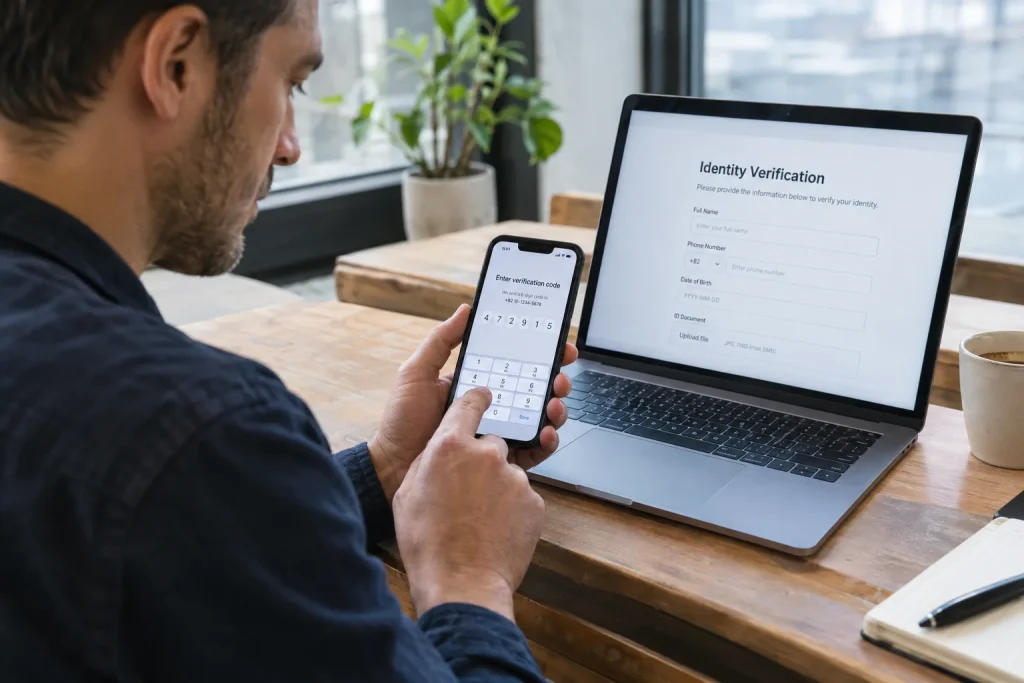
Why is Korean phone verification required so often in local apps? For many international visitors and new foreign residents, this is one of the most confusing parts of using digital services in South Korea.
You may be able to download an app, browse its content, and even create a basic account, but when you try to make a reservation, place an order, recover a password, verify an identity, or access a financial feature, the service may suddenly ask for mobile phone verification.
This is not simply an app preference. South Korea has a well-established online identity verification system, and mobile phones have become one of the most widely used ways to confirm who a user is.
If you are preparing your phone for a trip to Korea, it also helps to understand which local apps are most useful. Our guide to Naver Map vs KakaoMap vs Google Maps in Korea explains another part of the country’s local app ecosystem.
What Korean phone verification actually means
Korean phone verification is often more than receiving a simple text message.
A service may use your phone number as part of a formal identity verification process. The goal is to confirm that the person using the service is connected to verified personal information held by an approved identity verification provider.
The Korea Internet & Security Agency, or KISA, explains that Korea’s identity verification system was developed to reduce the use of resident registration numbers online. Instead, users can verify themselves through approved alternatives such as mobile phones, i-PIN, credit cards, or digital certificates.
SMS verification is not always the same as identity verification
This distinction is important.
Many international apps use SMS verification simply to prove that you control a phone number. The app sends a code, you enter the code, and the process is complete.
In Korea, some services use a more formal mobile identity verification process. The phone number may need to match the user’s registered identity information with a Korean mobile carrier.
This is why having access to a Korean phone number does not always mean that every verification screen will work.
Why the phone often needs to be registered in your own name
KISA’s guidance for mobile identity verification instructs users to select the carrier of a mobile phone subscribed in their own name before completing verification.
In other words, the system is designed to verify both the phone and the identity associated with the subscription.
This can create problems if:
- The phone plan is registered under another person’s name
- The SIM was purchased using a different identity record
- The account information does not match the information entered in the app
- The user is relying on a temporary data-only SIM
- The service does not support the user’s particular identity status
How the SMS verification process works
KISA describes a typical mobile verification process using SMS as follows:
- The user opens the mobile identity verification window.
- The user selects a mobile carrier and enters required personal information.
- A one-time password is sent by SMS.
- The user enters the code within the allowed time.
- The identity verification process is completed.
The one-time code confirms access to the phone, while the identity verification provider also checks the information associated with the mobile subscription.
What is PASS?
PASS is another commonly used method for mobile identity verification in Korea.
KISA explains that PASS can be used as a simplified authentication method instead of repeatedly entering SMS codes. Users can authenticate through the PASS app using methods such as a PIN, fingerprint, or other biometric option supported by the device and service.
The exact experience can vary depending on the mobile carrier and the service requesting verification.
Why Korean apps use identity verification so frequently
Identity verification is used across many kinds of online services in Korea.
KISA lists common uses such as:
- Creating an online account
- Recovering an account or password
- Managing account information
- Financial transactions and payments
Other services may also use identity verification when regulations, age restrictions, fraud prevention, or account security make stronger verification necessary.
Why Korean phone verification can be difficult for foreign visitors
Short-term visitors often expect that buying a Korean SIM will immediately unlock every Korean digital service. That is not always the case.
Some prepaid or travel SIMs are designed primarily for mobile data and basic communication. Even when they provide a Korean phone number, they may not support every domestic identity verification workflow.
Travelers may therefore encounter services that work perfectly for browsing but become inaccessible when a verified Korean identity is required.
Foreign residents have a different experience
Foreign residents who have completed local registration and have a mobile plan registered under matching identity information generally have access to more domestic verification services than short-term visitors.
However, the exact result still depends on the service, mobile carrier, identity information, and verification provider involved.
This is one reason why two foreign users in Korea can have very different experiences with the same app.
Why a travel eSIM may not solve the problem
A travel eSIM is excellent for getting internet access quickly, but internet access and domestic identity verification are separate issues.
A data-focused travel eSIM may let you use maps, messaging apps, translation services, and websites without difficulty. But if an app requires a mobile number tied to an identity record accepted by a Korean verification provider, the eSIM alone may not be enough.
What to do when verification fails
If a Korean app rejects your phone verification, first check what type of verification it is actually requesting.
Useful questions include:
- Is the service only asking for an SMS code?
- Does it require a phone number registered in your own name?
- Does the service support foreign residents?
- Does the app offer another identity method?
- Can the same task be completed through a website or in person?
Do not repeatedly enter random personal information or use another person’s identity details. Verification systems are designed to match identity information, and incorrect information can cause additional problems.
Are there alternatives to mobile verification?
Yes, depending on the service.
KISA lists four major identity verification alternatives: mobile phone verification, i-PIN, credit card verification, and certificate-based verification.
Not every website or app supports all four options. A service may offer only one or two methods.
For travelers, this means there is no universal workaround. If a specific app requires a verification method that you cannot access, using an alternative service may be the most practical solution.
What about Koreans living overseas?
Korea has also been expanding alternatives for people who cannot use a domestic mobile phone.
KISA has highlighted a remote identity verification system for registered overseas Koreans that can provide access to certain Korean online services without requiring a Korean mobile phone. This is a specialized system for eligible overseas Korean nationals rather than a general solution for foreign tourists, but it shows how the identity ecosystem continues to evolve.
A practical rule for visitors
Before relying on a Korean app for an essential task, check whether the feature you need requires identity verification.
This is especially important for:
- Payments
- Reservations
- Account recovery
- Financial services
- Age-restricted services
- Government or administrative services
For maps, translation, transit information, and many general travel functions, verification may not be necessary. For services connected to payments, identity, or regulated activities, stronger verification is more common.
Bottom line
Korean phone verification appears so often in local apps because the phone can be part of a formal identity verification system, not just a way to receive text messages.
The important distinction is between proving that you control a phone number and proving that the verified identity attached to that phone number is you.
Once you understand that difference, many of the confusing verification screens in Korean apps make much more sense.
Sources
- KISA — Introduction to Korea’s identity verification system
- KISA — Mobile phone identity verification
- KISA — Guide to mobile phone verification and PASS
- KISA — Alternative identity verification methods
- KISA — Remote identity verification for overseas Koreans
Updated: September 2026. Verification methods and app requirements can change, so confirm current requirements with the service you plan to use.