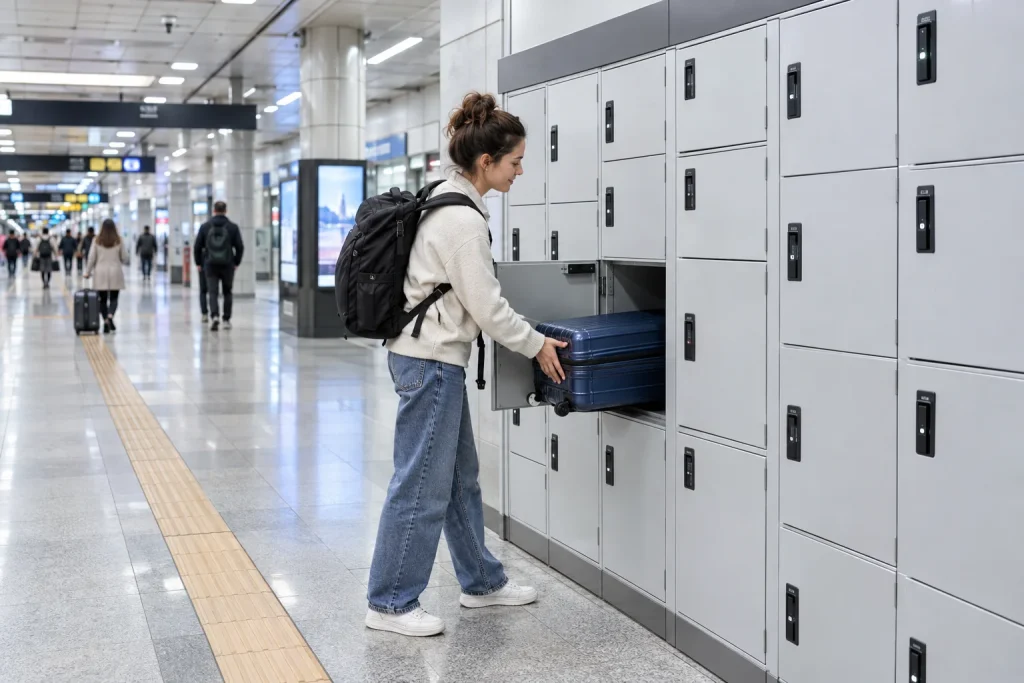
Korean luggage lockers for foreigners are a practical way to explore South Korea without carrying bags all day. Subway stations, train stations and transportation hubs often provide short-term storage options, and Seoul also operates dedicated services such as T-Locker and T-Luggage.
The exact system varies by station, but most travelers only need to understand four things: locker size, payment method, operating hours and how to retrieve the bag later.
This guide explains the basics.
Korean luggage lockers for foreigners: the quick answer
For most visitors, the process is simple:
- Find a locker or luggage-storage facility.
- Choose the correct locker size.
- Check the storage time and price.
- Pay using the available method.
- Store your luggage and complete the locking process.
- Save the locker number, password, QR code or receipt.
- Return before the facility closes or the paid time expires.
- Follow the retrieval instructions.
Do not assume every locker works exactly the same way.
Where can you find luggage lockers in Korea?
VISITKOREA states that lockers are installed at most subway stations.
You may also find storage options at:
- Major train stations
- Bus terminals
- Airports
- Tourist information centers
- Private luggage-storage businesses
Large transportation hubs usually offer the most options.
Seoul has an extensive T-Locker network
Seoul Metropolitan Government operates T-Locker, a subway-station storage service.
The city currently lists thousands of lockers across hundreds of Seoul subway stations.
This makes short-term luggage storage available in many neighborhoods rather than only at Seoul Station or the airport.
What is T-Luggage?
T-Luggage is a separate Seoul subway service focused specifically on traveler luggage.
It offers storage as well as same-day luggage delivery between supported locations.
Major T-Luggage locations include:
- Seoul Station
- Hongik University Station
- Jamsil Station
- Myeong-dong Station
- Gimpo International Airport Station
- Jongno 3-ga Station
T-Locker and T-Luggage are different
T-Locker is a self-service locker system.
T-Luggage is a staffed or dedicated luggage service that can also provide same-day delivery.
If you simply want to store a backpack for a few hours, a locker may be enough.
If you have large luggage or want to send bags to another location, T-Luggage may be more useful.
How much do Seoul subway lockers cost?
Seoul’s current T-Locker pricing is based on locker size and storage time.
Base rates are calculated for an initial four-hour period, with higher weekend pricing and additional hourly charges afterward.
Current Seoul guidance lists approximate base rates starting around:
- Small — 2,200 won on weekdays
- Medium — 3,300 won on weekdays
- Large — 4,400 won on weekdays
Weekend and holiday rates are higher.
Prices can change, so always check the actual screen or posted notice before confirming payment.
How large are the lockers?
T-Locker provides several sizes.
Seoul currently lists approximate dimensions of:
- Small — 50 × 30 × 60 cm
- Medium — 50 × 45 × 60 cm
- Large — 50 × 90 × 60 cm
Large suitcases may not fit every locker.
If you are traveling with oversized luggage, a dedicated luggage-storage counter may be easier.
Check the bag before paying
Before confirming payment, compare your suitcase with the locker opening.
A bag that technically matches the listed dimensions may still be difficult to insert if it has large wheels, a rigid shell or an unusual shape.
Do not force luggage into a locker.
How can you pay?
VISITKOREA notes that payment methods vary by locker.
Depending on the facility, payment may be possible with:
- Bank card
- Transportation card
- Cash at selected lockers
- App-based payment
Because the exact system differs, keep more than one payment method available.
Will a foreign credit card work?
Some machines accept international cards, while others may be designed mainly around Korean payment methods.
If a foreign-issued card fails, try another supported payment option rather than assuming the locker is unavailable.
For travelers, keeping some Korean won and a transportation card can be useful.
Some lockers use an app
Newer T-Locker facilities can be managed through the T-Locker app.
However, Seoul’s official guidance notes that the app is available only in Korean.
This can make older physical lockers or staffed luggage services easier for some foreign visitors.
Older lockers may have different instructions
Not every Seoul subway locker uses the same interface.
Older lockers may have instructions directly on the machine and can operate differently from newer app-connected lockers.
Follow the instructions shown on the exact locker you are using.
Most lockers have multilingual guidance
VISITKOREA states that many subway lockers provide instructions in multiple languages.
Look for an English-language button before using camera translation.
If English is unavailable, Papago or Google Translate can help with short instructions.
Save the locker information immediately
Before walking away, save whatever information is required to retrieve your bag.
This may include:
- Station name
- Locker number
- Password or PIN
- QR code
- Receipt
- Exact locker location inside the station
A screenshot can be especially useful.
Remember which station exit you used
Large Korean subway stations can have many exits and several underground levels.
Knowing only the station name may not be enough to quickly find the locker again.
Save a note such as:
“Myeong-dong Station, basement level near Exit 9.”
This can save considerable time later.
Locker access depends on station operating hours
Seoul’s T-Locker service is available during specified operating hours.
The current city guidance lists storage and retrieval hours generally between early morning and midnight.
You cannot assume that a subway locker will be accessible 24 hours a day.
Do not plan a midnight retrieval without checking
If you have a late-night flight or bus, confirm the storage facility closing time before leaving your luggage.
A bag inside a closed station is not useful even if the locker itself technically still contains your belongings.
What happens if you exceed the paid time?
Additional fees can apply after the initial storage period.
For T-Locker, Seoul publishes extra hourly charges based on locker size.
Check the pricing screen before storing your bag so you understand what happens if you return later than planned.
Long-overdue luggage can become a problem
Storage services have rules for luggage that remains far beyond the agreed period.
Seoul warns that expired storage may eventually be moved, donated or discarded according to the service terms.
Do not use a short-term locker as long-term storage.
What should you not put in a locker?
Do not leave high-risk or prohibited items.
Restrictions can include:
- Cash and valuables
- Weapons
- Explosives or flammable items
- Animals
- Perishable or unsuitable items
- Other prohibited goods listed by the facility
Keep passports, wallets, expensive electronics and irreplaceable items with you whenever possible.
Do not store your passport if you can avoid it
A locker is useful for luggage, not for your most important identity document.
Keep your passport and essential travel documents in a secure bag that stays with you.
This is especially important if you need identification later that day.
T-Luggage can handle larger suitcases
Dedicated T-Luggage storage can be easier when a normal locker is too small.
Seoul lists several luggage sizes with different storage prices.
This is useful for travelers carrying large rolling suitcases after hotel checkout.
Same-day luggage delivery can save time
T-Luggage also provides same-day delivery between supported subway stations and, on some routes, between stations and Incheon Airport.
This can be useful when you want to sightsee without returning to your hotel for luggage.
Delivery availability, cutoff times and prices should be checked before relying on the service.
A common use case: hotel checkout before an evening flight
Imagine your hotel checkout is at 11 AM but your flight leaves late in the evening.
You could:
- Check whether the hotel will store luggage for free.
- Use a nearby subway locker.
- Use T-Luggage at a major station.
- Use same-day luggage delivery if the route fits your schedule.
The best option depends on your final sightseeing area and airport route.
Always ask the hotel first
Many hotels will store luggage before check-in or after checkout for guests.
If your hotel provides this service for free, it may be easier than paying for a subway locker.
Use lockers when hotel storage is unavailable or inconvenient for your route.
Lockers are useful during day trips
A locker can also help when:
- You arrive in a city before hotel check-in
- You have shopping bags you do not want to carry
- You are transferring between hotels
- You are making a short stop between train journeys
- You want to explore near a station with only a small bag
Check availability before depending on one locker
Popular stations can have high demand.
A large locker may not be available when you arrive.
If your plan depends on storage, identify a second nearby station or dedicated luggage facility as a backup.
Large stations may have more than one locker area
Major stations can have several separate storage areas.
If one locker bank is full, another part of the station may still have availability.
Check station maps or ask staff before giving up.
Use Korean map apps to locate storage areas
NAVER Map and KakaoMap can help you reach the station and understand exit locations.
However, very detailed underground locker positions may not always be obvious on the map.
Station signage and official information remain important.
A practical locker routine for travelers
Use this sequence:
- Decide how many hours you need storage.
- Check whether your hotel can store the bag first.
- Find a subway locker or luggage service near your route.
- Confirm the bag fits.
- Check the payment method and operating hours.
- Pay and lock the luggage.
- Save the locker number and retrieval information.
- Take a photo of the exact location.
- Return before closing time.
Common mistakes foreign visitors make
- Assuming every locker accepts foreign cards
- Choosing a locker before checking whether the suitcase fits
- Forgetting the exact location inside a large station
- Failing to save the password or retrieval code
- Assuming the station is accessible 24 hours
- Leaving valuables or passports inside
- Returning after the planned storage period without checking extra fees
- Assuming every station has large lockers available
Korean luggage lockers for foreigners are easy once you know the system
Subway lockers are one of the most useful travel conveniences in South Korea.
They allow you to explore a neighborhood, wait for hotel check-in or spend your final travel day without dragging luggage around.
The main rule is simple: check the locker size, payment method, retrieval process and operating hours before leaving your bag.
Related BestSpot Guides
- how to book KTX train tickets in Korea
- how to read Korean subway exit numbers
- Naver Map vs KakaoMap vs Google Maps in Korea
Bottom line
Korean luggage lockers for foreigners are widely available in subway stations and major transportation areas.
Choose the correct locker size, confirm how to pay, save the locker location and retrieval information, and return before the station or facility closes.
For oversized luggage or same-day delivery, Seoul’s T-Luggage service can be a useful alternative to ordinary lockers.
Sources
- Seoul Metropolitan Government — Subway Storage Facilities
- VISITKOREA — Subway Travel and Locker Information
Updated: October 2026. Locker locations, operating hours, prices, payment methods and delivery services can change.