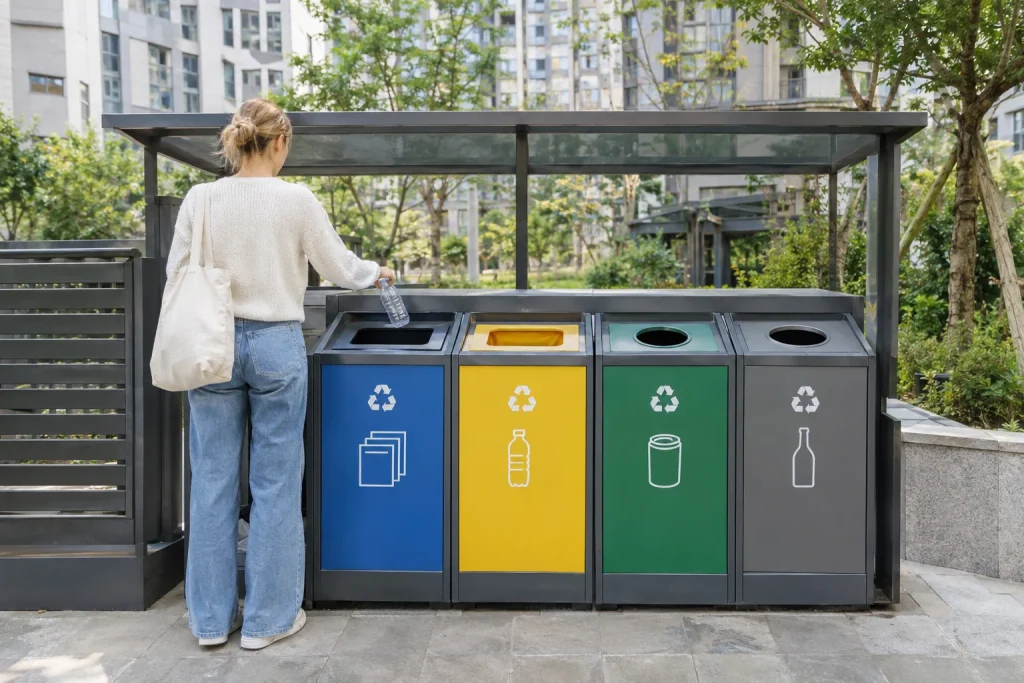
Korean trash and recycling for foreigners can feel surprisingly complicated at first. South Korea separates general trash, food waste and recyclable materials, and the exact collection rules can vary depending on where you are staying.
For a short-term visitor in a hotel, the process is usually simple because the accommodation handles most waste disposal. For travelers staying in guesthouses, apartments or long-term rentals, understanding Korea’s sorting system becomes much more important.
This guide explains the practical basics without assuming that every neighborhood follows exactly the same schedule.
Korean trash and recycling for foreigners: the quick answer
The basic system usually separates waste into three major groups:
- General trash — ordinary non-recyclable waste
- Food waste — eligible leftover food
- Recyclables — items such as paper, plastic, cans and glass when properly separated
Collection days, bag requirements and disposal locations can vary by district or building.
Why Korea separates trash so carefully
Korea uses waste separation to encourage recycling and reduce the amount of material sent for disposal.
In Seoul, residents are expected to separate recyclable materials and use designated systems for general and food waste.
Visitors staying in residential accommodation may need to follow the same rules as local residents.
Hotels are usually easier
If you are staying in a normal hotel, you usually do not need to purchase official garbage bags or learn the district collection schedule.
Use the bins provided in your room and follow any recycling instructions displayed by the hotel.
For unusually large amounts of waste, ask the front desk what to do.
Apartment and guesthouse stays are different
If you stay in an apartment, Airbnb-style rental, guesthouse or residence for several days or weeks, your host may expect you to separate your own trash.
Ask the host:
- Where general trash goes
- Where food waste goes
- Where recyclables are collected
- Which bags are required
- Which days and times disposal is allowed
This is much more reliable than assuming the rules are identical throughout Korea.
What is a standard garbage bag?
Many areas use official volume-based garbage bags for general waste.
These are commonly called 종량제 봉투.
They are sold in different sizes and are associated with the local waste-disposal system.
If your accommodation requires these bags, ask the host which type and size to buy.
Where can travelers buy garbage bags?
Official garbage bags are commonly sold at local convenience stores and supermarkets.
However, the correct bag can depend on the local district.
Do not buy a large quantity before confirming what your accommodation requires.
What counts as general trash?
General trash typically includes non-recyclable household waste that is not eligible food waste.
Examples may include:
- Used tissues
- Heavily contaminated packaging
- Disposable items that cannot be recycled
- Other ordinary non-recyclable household waste
Local instructions should take priority when an item is unclear.
Food waste is a separate category
Korean food-waste rules can surprise foreign visitors because not every leftover from cooking or eating belongs in the food-waste bin.
In Seoul, food waste should generally have excess moisture and foreign objects removed before disposal.
Large pieces may also need to be cut smaller depending on the item and local system.
Some food-looking items are not food waste
Seoul’s food-waste guidance lists several items that should not be disposed of as food waste.
Examples include:
- Animal bones
- Fish bones
- Shellfish shells
- Crab and lobster shells
- Egg shells
- Hard fruit pits
- Hard nut shells
- Onion, garlic and similar tough vegetable skins
- Tea leaves and certain grounds
These items generally belong in another waste category rather than the food-waste system.
Remove packaging from food waste
Plastic bags, bottle caps, disposable chopsticks, toothpicks, foil and other non-food objects should not be mixed into food waste.
If you have takeaway food, separate the remaining food from its plastic or paper packaging before disposal.
What about salty foods?
Seoul’s guidance recommends reducing excessive salt or seasoning before disposing of very salty foods such as kimchi, doenjang or gochujang-based leftovers.
Follow the instructions provided by your building or district for the exact disposal method.
How are recyclables separated?
Recycling systems commonly separate materials such as:
- Paper and cardboard
- Plastic containers
- Plastic film or vinyl where collected separately
- Glass bottles
- Metal cans
The categories available at your building may be more detailed.
Rinse recyclable containers when practical
Food or liquid residue can make recycling more difficult.
Empty containers and remove significant residue before placing them in the recycling area.
If a package contains several different materials, separate them when the local instructions require it.
Remove obvious non-recyclable parts
Caps, labels, pumps and other components may sometimes need to be separated from the main container.
The exact requirement depends on the material and local collection system.
Use the signs at the recycling station as your primary guide.
Apartment recycling areas can look complicated
Large Korean apartment complexes often have dedicated recycling areas with several containers or sections.
You may see separate spaces for:
- Paper
- Cardboard
- Plastic
- Vinyl
- Glass
- Cans and metal
Do not worry if you cannot understand every Korean label immediately. Camera translation can help.
Use Papago or Google Translate on recycling signs
Recycling areas often contain short Korean labels that are ideal for camera translation.
Instead of guessing, point your phone camera at the sign before throwing something away.
This is especially useful in apartment buildings where the sorting system may be more detailed than expected.
Trash collection days are not universal
This is one of the most important things for foreigners to understand.
Seoul’s districts can have different disposal schedules, and some neighborhoods may have their own designated days or times.
Do not assume that because trash was placed outside yesterday, you can do the same tonight.
Ask your host about disposal time
A simple message to your accommodation host can prevent most mistakes:
“What day and time should I put out general trash, food waste and recycling?”
Save the answer on your phone so you do not need to ask repeatedly.
Do not leave garbage anywhere outside
Putting a bag on a random street corner because other bags are nearby is risky.
The area may have a designated pickup location and schedule.
Use the place specifically instructed by your building, host or local authority.
What if you are leaving Korea tomorrow?
If your normal disposal day is later than your departure date, do not simply abandon the trash outside.
Ask your hotel, host or property manager how to handle the remaining waste.
Many accommodations can provide a practical solution for departing guests.
Convenience stores are not public garbage stations
A convenience store may have small bins for waste generated by customers using that store.
That does not mean you should bring a bag of household garbage from your accommodation and leave it there.
Dispose of residential waste through the proper residential system.
Public street bins can be limited
Foreign visitors sometimes expect large public garbage bins on every street.
In Korea, public bins may be less common than expected in some areas.
For small personal trash, you may need to keep it with you until you reach an appropriate disposal point.
What about takeaway cups and food containers?
Empty the remaining drink or food first.
If the container is recyclable, follow the local recycling instructions.
If it is heavily contaminated or made of mixed non-recyclable materials, it may need to be treated as general waste.
When in doubt, ask your accommodation rather than guessing.
Large items use a different system
Furniture, mattresses, appliances and other bulky items do not belong in ordinary household garbage bags.
Korea uses separate disposal procedures for large waste.
Short-term visitors should contact the accommodation owner or manager instead of attempting to dispose of a large item themselves.
A practical trash routine for travelers
If you are staying outside a normal hotel, use this routine:
- Ask the host how waste is separated.
- Confirm whether official garbage bags are required.
- Check the disposal location.
- Check the allowed day and time.
- Keep food waste separate.
- Separate recyclables according to the building signs.
- Use camera translation when needed.
Common mistakes foreign visitors make
- Putting food waste into the general trash without checking local rules
- Assuming bones and shells are food waste
- Mixing plastic packaging into food waste
- Using the wrong garbage bag
- Putting garbage outside on the wrong day
- Leaving household trash at a convenience store
- Assuming all Seoul districts use exactly the same schedule
Korean trash and recycling for foreigners is easier with one local rule
The best rule is simple: follow the instructions for the exact building and neighborhood where you are staying.
Korea has a structured waste system, but the practical details can vary.
Your hotel, host, apartment management office or local district information is the best source for the final disposal instructions.
Related BestSpot Guides
- how to use Korean convenience stores as a foreigner
- how to use a Korean coin laundry as a foreigner
- how Korean addresses work
Bottom line
Korean trash and recycling for foreigners becomes manageable once you separate general trash, food waste and recyclables and then follow the rules of your specific accommodation and district.
Hotel guests usually have very little to worry about. Apartment and long-term rental guests should confirm the correct bags, recycling area and collection schedule with the host.
When you are unsure, do not guess. A quick message to your accommodation or a translated disposal sign is usually enough to avoid a mistake.
Sources
- Seoul Metropolitan Government — Living in Seoul Guidebook
- Seoul Metropolitan Government — Food Waste Separation and Disposal Standard
Updated: October 2026. Garbage bags, collection days, food-waste methods and recycling rules can vary by district and accommodation.