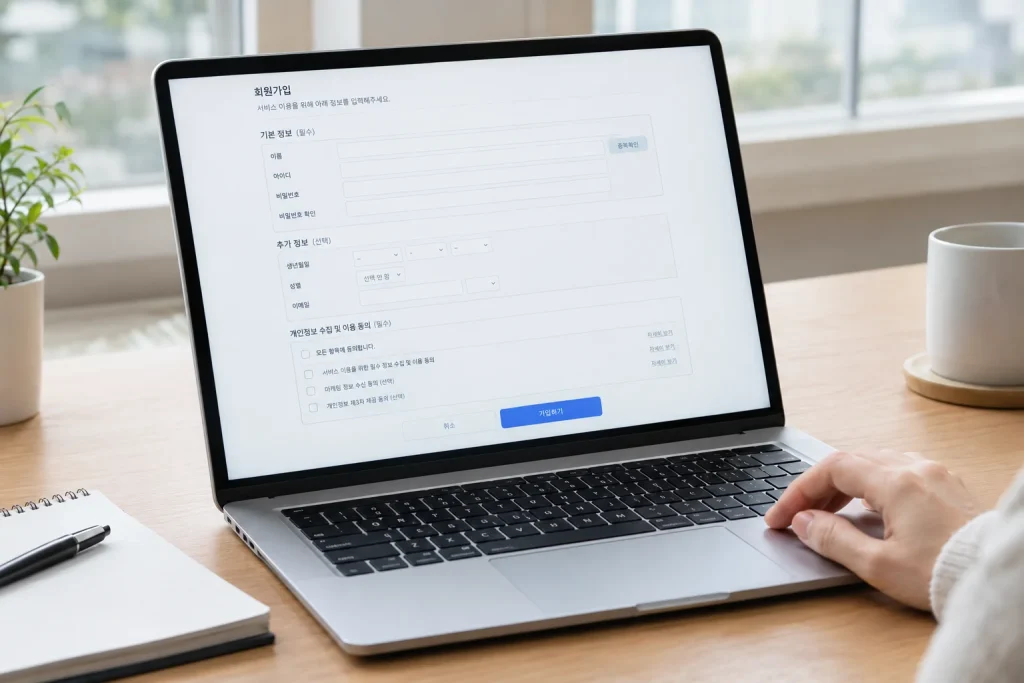
Why Korean websites ask for personal information can be confusing to foreign visitors who are used to creating online accounts with only an email address and password.
In South Korea, websites and apps may ask for information such as your name, date of birth, mobile phone number, nationality, or identity-verification details when you sign up, make a reservation, pay online, or access age-restricted services.
That does not mean every Korean website is legally allowed to collect whatever it wants. Korean privacy law requires organizations to limit collection to information that is necessary for the stated purpose.
Why Korean websites ask for personal information: the quick answer
The main reasons are usually:
- Account identification
- Real-name or identity verification
- Mobile phone verification
- Age verification
- Payments and fraud prevention
- Reservations and customer service
- Legal or regulatory requirements
Different services require different levels of information.
Email login and identity verification are not the same thing
A website can let you create an account with an email address but still require stronger identity verification for certain features.
For example, signing in may be enough to browse content, while payment, adult verification, financial services, or account recovery may require additional personal information.
This distinction is important when using Korean digital services.
Why mobile phone numbers appear so often
Mobile phone verification is commonly used in Korea for account security and identity-related services.
The Personal Information Protection Commission operates a service that allows users to review identity-verification history involving mobile phones, I-PIN, and resident-registration-number-based verification.
This reflects how frequently identity verification has been used for membership, age verification, and real-name confirmation on Korean websites.
Receiving an SMS code is not always full identity verification
There are several different levels of phone-based verification.
A simple SMS code may only prove that you control a phone number.
Stronger Korean identity verification can also compare:
- Name
- Date of birth
- Mobile carrier information
- Subscriber identity
- Other account details
This is why a visitor can sometimes receive Korean text messages but still fail identity verification.
Why name and date of birth are frequently requested
Name and date of birth can be used to distinguish users, verify identity, confirm eligibility, and match records across services.
They can also be relevant to age-restricted services.
For foreign users, differences in name spelling or order can sometimes create problems when website information does not match passport or telecom records.
Age verification creates additional requests
Some Korean online services need to determine whether a user meets an age requirement.
This can apply to certain:
- Products
- Media
- Games
- Alcohol-related services
- Adult-only content
A simple checkbox saying “I am over 18” may not always be enough for the service’s verification process.
Payment services can require more information
Online payments can involve more identity information than an ordinary in-store card transaction.
A Korean service may connect payment authorization with:
- Account information
- Phone verification
- Cardholder information
- Fraud-prevention checks
- Payment-provider requirements
This helps explain why a foreign card may work in a physical store but fail inside a Korean app or website.
Reservations can also require personal information
Restaurants, hotels, clinics, activities, and appointment services may need information to manage a reservation.
Typical information can include:
- Name
- Phone number
- Email address
- Number of visitors
- Reservation time
The exact requirements depend on the business and booking system.
Korean privacy law still limits collection
South Korea’s Personal Information Protection Act does not give websites unlimited authority to collect information.
Article 16 requires personal-information handlers to collect only the minimum information necessary for the purpose.
The organization is responsible for demonstrating that the information is necessary.
Optional information should be treated differently
When a company collects information based on user consent, Korean law distinguishes between necessary information and additional information.
Users must be informed that they can refuse collection of information beyond what is necessary.
A company generally cannot refuse to provide a product or service simply because a user does not agree to provide unnecessary additional information.
Consent screens can look overwhelming
Korean signup pages often contain several consent boxes.
These can involve:
- Terms of service
- Personal-information collection
- Third-party sharing
- Marketing messages
- Location information
- Optional promotional consent
Foreign users may interpret the entire screen as one large privacy request even when some items are optional.
Do not automatically select every checkbox
Read the required and optional labels carefully.
Marketing messages, promotional notifications, and some additional data uses may be optional.
If the interface provides separate choices, only agree to optional items that you actually want.
What does third-party sharing mean?
Some services need to send information to another company in order to provide a specific function.
This can involve:
- Payment processors
- Delivery companies
- Reservation providers
- Identity-verification companies
- Customer-service providers
Korean privacy law regulates when personal information can be provided to third parties, including situations based on consent or specific legal grounds.
Why identity verification developed so strongly in Korea
Korea developed a highly integrated online environment involving membership websites, mobile communications, e-commerce, online payments, and digital government services.
Strong identity-verification systems became part of many of these services.
The Personal Information Protection Commission specifically identifies issues such as identity theft, misuse of personal information, and fraudulent accounts as reasons for maintaining tools that let people review their verification history.
Foreign visitors can face extra friction
Many Korean systems were originally designed primarily around domestic identity records and Korean mobile subscriptions.
A short-term visitor may have:
- A foreign passport
- A tourist SIM
- A foreign credit card
- No Korean resident registration information
That combination can make some verification systems harder to use.
Services are gradually adding alternatives for foreigners
Some Korean platforms have introduced options designed specifically for international visitors.
Examples include passport-based verification, foreign-card payment options, international versions of apps, and services that do not require a Korean phone number.
These alternatives are becoming increasingly important as Korea receives more international visitors.
What should you do when a website asks for unfamiliar information?
Before entering anything sensitive, check:
- What service you are using
- Why the information is requested
- Whether the field is required or optional
- Whether the website is the official service
- Whether a foreign-user option exists
Do not provide information simply because a page asks for it.
Be especially careful with resident registration numbers
Foreign visitors should not attempt to invent or substitute Korean identity information.
If a website requires an identification method you do not have, look for a foreign-user route or contact the service provider.
Using incorrect identity information can create account and security problems.
You have privacy rights in Korea
Korean privacy law gives individuals rights regarding their personal information.
These include rights related to accessing personal information, requesting correction or deletion, and requesting suspension of processing under applicable conditions.
The Personal Information Protection Commission also operates services that help users review identity-verification history and request withdrawal from certain websites.
Less information is not always better
A request for personal information is not automatically suspicious.
A legitimate reservation service may genuinely need your name and contact information.
A payment provider may need information to process or secure a transaction.
The more useful question is whether the information requested is appropriate for the service being provided.
More information is not always necessary either
The opposite is also true.
If a simple service asks for extensive personal information unrelated to its purpose, that should make you more cautious.
Korean privacy law’s minimum-necessary principle is designed to limit unnecessary collection.
Why Korean websites ask for personal information can vary by service
Why Korean websites ask for personal information does not have one universal answer.
A shopping site, bank, reservation system, gaming service, hospital, and government website can all have very different reasons and legal requirements.
Understanding the difference between account information, identity verification, payment information, and optional marketing data makes Korean websites much easier to navigate.
Related BestSpot Guides
- why Korean apps ask for phone number verification
- why a Korean phone number does not always mean identity verification
- why Korean apps use Naver and Kakao login
Bottom line
Why Korean websites ask for personal information usually comes down to account management, identity verification, age checks, payments, reservations, security, or legal requirements.
But Korean privacy law also requires organizations to limit collection to information necessary for the stated purpose.
When using a Korean website, distinguish required information from optional consent, use foreign-user alternatives when available, and only provide personal data when you understand why it is needed.
Sources
- Korea Law Information Center — Personal Information Protection Act
- Personal Information Protection Commission — Access and Identity Verification History
- Korea Privacy Portal — Personal Information and Identity Verification Services
Updated: September 2026. Privacy rules, verification methods, consent interfaces, and foreign-user options can change.