T-money for visitors to South Korea is one of the easiest ways to pay for buses and subways without buying a separate ticket for every ride.
For most short-term travelers, a physical T-money card is simple: buy the card, add Korean won, tap when entering public transportation, and tap again when leaving where required.
The card is widely used across South Korea and is especially useful in Seoul, where buses and subways are heavily integrated.
T-money for visitors to South Korea: the quick answer
T-money is a rechargeable prepaid transportation card.
Visitors can use it on many public transportation systems, including subways and city buses, and it can also work at some affiliated taxis, convenience stores, and other locations.
For most tourists, the main reason to carry one is simple: it makes everyday transportation much easier.
Where can visitors buy a T-money card?
VISITKOREA lists convenience stores such as GS25, CU, and 7-Eleven among common purchase locations.
Cards are also available through some subway-station information centers and ticket or card machines.
Availability can vary by location, so a convenience store near a subway station is often the easiest place to start.
How much does the card itself cost?
The physical card has its own purchase price, separate from the transportation balance loaded onto it.
VISITKOREA currently lists typical card prices in the range of several thousand won, depending on the card type and design.
The purchase price of the card is generally not the same thing as the stored-value balance.
How do you add money to T-money?
T-money is prepaid, so you normally add Korean won before riding.
Reloading is available at many convenience stores and subway ticket or reload machines.
Payment methods for reloading can depend on the location and machine, so travelers should keep some Korean won available as a backup.
Do you need a Korean bank account?
No Korean bank account is required to use a normal physical T-money card for everyday transportation.
This is one reason the physical card remains convenient for short-term visitors.
You can use the balance already loaded onto the card without creating a Korean banking account.
How do you use T-money on the subway?
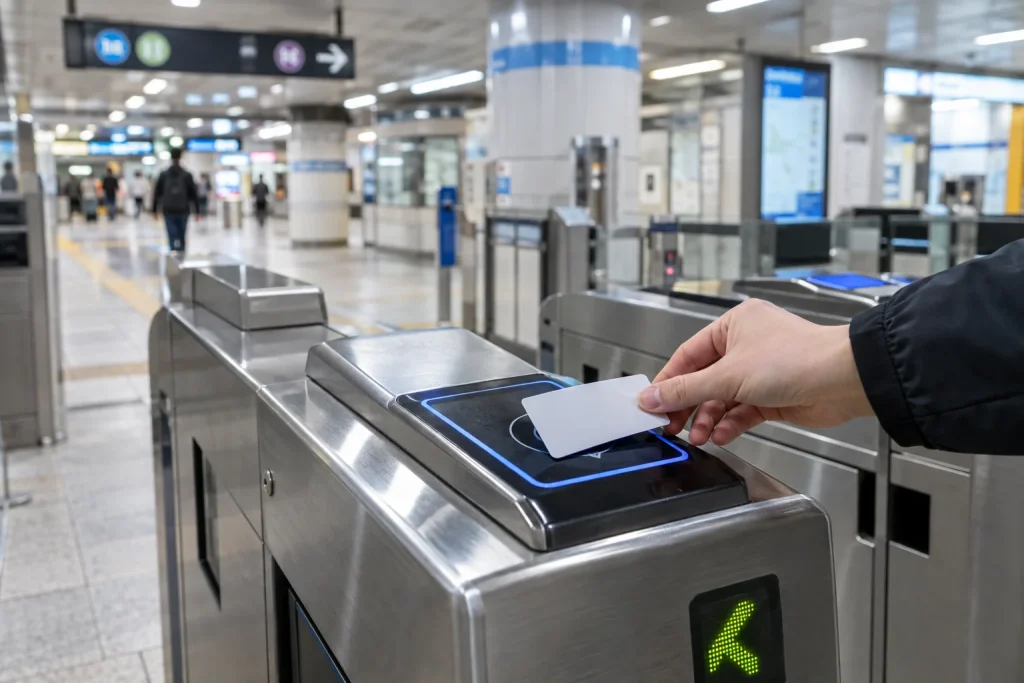
At a subway station, tap the card on the reader when entering through the gate.
When you reach your destination, tap again when leaving.
The fare is calculated automatically from the transportation system.
If the balance is too low, the gate may reject the card until you reload it.
How do you use T-money on a bus?
On buses, tap the card when boarding.
In systems that use distance-based fares and transfer discounts, tapping again when getting off is important.
Do not simply walk off the bus without tapping because that can affect fare calculation or future transfer discounts.
Why tapping when you get off matters
Korean public transportation systems often calculate fares and transfers based on both the boarding and exit information.
The second tap helps the system determine the completed trip.
It also helps preserve eligible transfer discounts between buses and subways.
Can one T-money card be shared?
For ordinary travel, each person should generally have their own transportation card.
This is especially important when using subway gates and transfer discounts because the system tracks individual travel sequences.
A group of travelers should not rely on one card as their only transportation card.
Where does T-money work?
VISITKOREA lists T-money as usable across a wide range of subway and bus systems throughout South Korea.
Coverage includes the Seoul metropolitan area as well as many other major cities and regions.
That makes the card useful even if your trip is not limited to central Seoul.
Can T-money be used in taxis?
Some taxis accept T-money and other transportation cards.
However, payment options can vary by taxi and terminal.
If you plan to use a taxi, it is still sensible to have another payment option available.
Can T-money be used outside transportation?
T-money can also be accepted at some affiliated convenience stores, vending machines, and other merchants.
For most visitors, though, transportation remains the most important use.
Do not assume that every store will accept it simply because the store accepts ordinary credit cards.
How much money should you load?
There is no need to load a very large amount immediately.
A practical approach is to start with a modest balance and reload when needed.
This reduces the amount left on the card when you leave Korea.
Why loading smaller amounts is practical
VISITKOREA advises travelers not to leave unnecessarily large balances on transportation cards because larger refunds can require more complicated procedures.
For a short trip, frequent small reloads are usually simpler than loading a very large amount on the first day.
Can you get the remaining balance refunded?
Refunds are available, but the procedure depends on the remaining balance and the type of card.
Smaller refunds may be available at participating convenience stores, while larger balances can require a dedicated service location.
Travelers should check the current refund rules before leaving Korea.
Does T-money give transfer discounts?
T-money can provide transfer discounts when moving between eligible buses and subways within the applicable transfer conditions.
This is one of the main advantages over paying separately for every segment of a journey.
To receive the correct transfer treatment, remember to tap properly when boarding and getting off.
Is T-money the same as the Climate Card?
No.
T-money is a rechargeable stored-value transportation card.
The Climate Card is a separate Seoul-focused transit product with specific unlimited-use pass options and service areas.
Visitors should choose between them based on how much they expect to travel and where they plan to go.
What about WOWPASS and EZL?
T-money is not the only transportation card available to visitors.
VISITKOREA also lists EZL and WOWPASS among options used by international travelers.
WOWPASS combines transportation functionality with additional payment and foreign-currency features, while EZL is another rechargeable transportation card.
For a traveler who only wants a simple transit card, a standard T-money card is often enough.
Should you buy T-money at the airport?
You can buy transportation cards at or near major arrival points, but you do not have to purchase one at the airport specifically.
If your first trip from the airport uses another ticket type, you can also buy T-money later at a convenience store or subway station.
The important thing is to have a usable transportation card before you begin relying heavily on buses and subways.
Common T-money mistakes visitors make
- Forgetting to tap when getting off a bus
- Loading too much money at once
- Assuming every foreign credit card can reload the card everywhere
- Confusing T-money with unlimited-ride tourist passes
- Throwing the card away before checking the remaining balance
A practical T-money routine for travelers
- Buy one physical T-money card per traveler.
- Load a modest amount of Korean won.
- Tap when entering subway gates.
- Tap when leaving subway gates.
- Tap when boarding buses.
- Tap again when getting off buses.
- Check the balance occasionally and reload as needed.
- Use or refund the remaining balance before departure if appropriate.
Bottom line
T-money for visitors to South Korea is one of the simplest tools for everyday transportation.
It works across a wide range of buses and subways, supports integrated fare and transfer systems, and does not require visitors to buy a separate ticket for every ordinary trip.
Buy a card, keep a reasonable balance on it, and remember to tap correctly when boarding and leaving.
Sources
- VISITKOREA — Transportation Cards
- VISITKOREA — T-money and Transportation Card Guide
- Seoul Metropolitan Government — Public Transportation Guide
Updated: September 2026. Transportation fares, reload methods, refund procedures, accepted locations, and tourist pass rules can change.