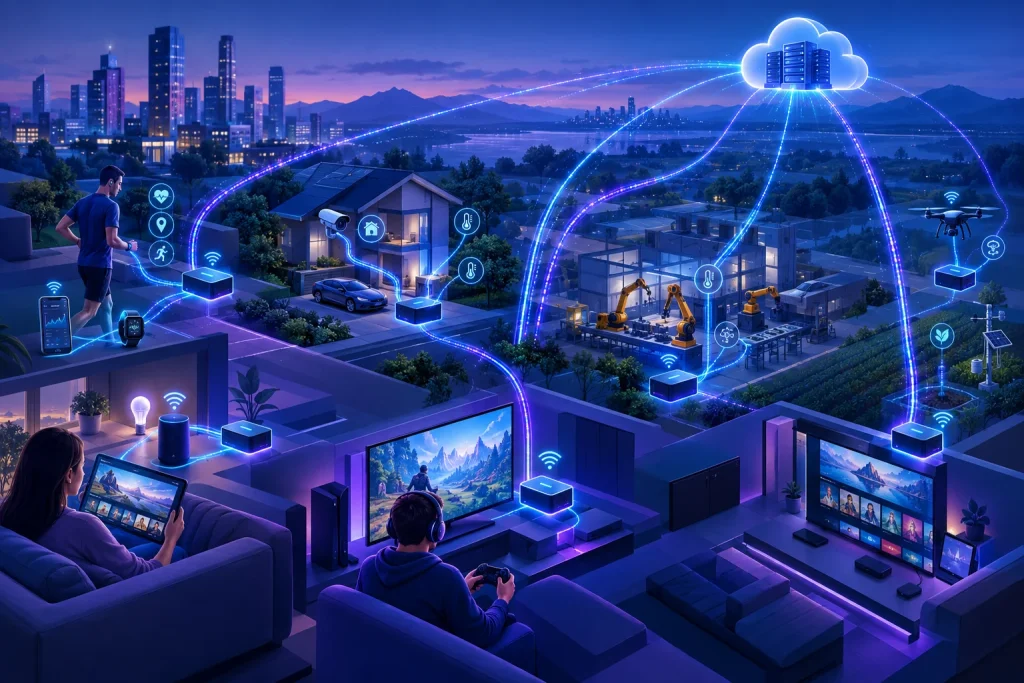
Edge computing is a distributed approach to computing in which at least some data processing happens close to the users, devices, or systems that generate and consume the data. Instead of sending every request to a distant central data center, an application can perform suitable work on a nearby device, gateway, server, or regional network location.
The main goals are straightforward: shorten the distance data must travel, produce faster responses, and avoid moving more information across a network than necessary. These qualities make the edge useful for interactive applications, connected devices, media delivery, and artificial intelligence workloads that need timely results.
Edge systems do not make cloud computing obsolete. In most practical designs, the edge and the cloud work together. Nearby infrastructure handles time-sensitive or location-specific tasks, while centralized cloud platforms provide large-scale storage, coordination, analytics, model training, and application management.
What Is Edge Computing?
The term “edge” describes the outer part of a network, closer to where digital activity occurs. That location is relative rather than fixed. The edge could be a processor inside a camera, a gateway in a building, a server at a telecommunications site, or infrastructure in a data center near a population center.
For example, a smart camera might analyze video locally and transmit an alert only when it detects a relevant event. A website could run request-handling logic at a nearby network location rather than forwarding every interaction to its central origin server. In both cases, some processing moves closer to the source or destination of the data.
An edge architecture may include several layers:
- On-device computing: Processing occurs directly on a phone, sensor, camera, vehicle, appliance, or industrial controller.
- Local gateways: A nearby gateway collects information from multiple devices, translates protocols, filters data, or makes local decisions.
- Network edge infrastructure: Servers operated in distributed locations process requests close to users or connected systems.
- Regional and central clouds: Larger facilities store long-term data, coordinate applications, and run workloads that do not require an immediate local response.
Not every application uses all these layers. The appropriate design depends on response-time requirements, connectivity, data volume, security, cost, and the processing capacity available at each location.
How Edge Computing Reduces Latency
Latency is the delay between an action and a response. It includes more than computation time. Data also has to cross physical distance, pass through network equipment, and sometimes wait for other traffic or server resources.
Moving suitable processing closer to a user can reduce the number and length of network trips. A request may be answered by a nearby server without traveling to an origin data center and back. A device may also make a local decision without depending on an external connection.
This does not guarantee that every edge-based operation will be faster. Performance still depends on software design, hardware capacity, routing, congestion, and the work being performed. However, reducing unnecessary network travel removes one important source of delay.
The benefit is most noticeable when applications require frequent interaction. Online games must exchange changing state, media services need to begin and continue playback smoothly, and automated equipment may need to react promptly to sensor input. Even small delays can become visible when they occur repeatedly throughout an experience.
How It Reduces Bandwidth Use
Connected devices can generate large streams of raw information. Sending all of that data to a centralized platform may consume significant network capacity, particularly when video, audio, or continuous sensor readings are involved.
Edge processing can filter, compress, summarize, or classify data before transmission. A sensor gateway might send periodic summaries instead of every reading. A camera could transmit event metadata rather than a continuous feed when full video is not needed. Local software might also discard duplicate or irrelevant information.
This approach reduces upstream traffic and can make applications less dependent on constant high-capacity connectivity. It may also lower the amount of centralized storage required. The raw data still needs to be transmitted when an application, audit process, or regulatory policy requires it, so bandwidth savings depend on what can safely be processed or retained locally.
Edge Computing vs. Traditional Cloud Computing
Traditional cloud computing concentrates applications, storage, and computing resources in provider-operated data centers. Customers can access scalable infrastructure without buying and maintaining every physical server themselves. Centralization also makes it easier to pool resources, administer software, and analyze information from many locations.
Edge computing distributes selected resources across more locations. Its strength is proximity, not necessarily greater computing power. An edge node may have limited storage and processing capacity compared with a large cloud region, but it can respond closer to the place where the data is needed.
The two models differ in several practical ways:
- Location: Cloud workloads commonly run in centralized or regional facilities, while edge workloads run nearer to users and devices.
- Response path: Edge processing can shorten the network journey for time-sensitive requests.
- Capacity: Central clouds generally offer broader pools of computing and storage resources.
- Connectivity: Some edge systems can continue limited local operation during a slow or interrupted external connection.
- Management: Distributed infrastructure creates more locations, devices, and software instances to monitor and secure.
A common hybrid pattern sends immediate work to the edge and later synchronizes data with the cloud. The cloud can maintain a global view, distribute application updates, train AI models, and retain historical records. Edge nodes can apply those models or policies locally.
Where Edge Computing Is Used
Streaming and content delivery
Media and web content can be cached at distributed servers near audiences. When a requested file is already available nearby, it does not need to be fetched from the origin for every viewer. This reduces traffic to central systems and can improve startup and delivery consistency.
Edge locations can also perform request routing, access checks, image transformation, or other lightweight application functions. The exact capabilities vary by platform, but the underlying idea is to handle appropriate work before a request reaches the origin.
Readers comparing software and media services can find additional coverage in BestSpot’s app guides.
Cloud gaming and multiplayer games
Games are highly sensitive to network delay because players expect the system to react quickly to input. Nearby servers can shorten communication paths for multiplayer coordination or game streaming. Edge infrastructure may also help route players to an appropriate session or process selected real-time events.
It cannot eliminate latency caused by a player’s local connection, device, display, or game engine. It can, however, reduce avoidable distance between a player and the computing environment.
Smart homes, cities, and industrial systems
Smart devices often need to interpret sensor data and trigger actions. Local processing can allow lights, alarms, machinery, or environmental controls to operate without waiting for a round trip to the cloud.
In industrial environments, gateways may aggregate readings from equipment and forward only exceptions or summaries. This can preserve network capacity and support limited operation when external connectivity is unavailable. Central platforms remain valuable for fleet management, maintenance records, and analysis across multiple sites.
Artificial intelligence
Edge AI typically refers to running AI inference near the point where data is produced. A device or nearby server applies a trained model to recognize an object, transcribe speech, identify an anomaly, or make another prediction.
Local inference can produce a faster response and limit the need to upload raw data. It may also support privacy goals when sensitive information can remain on a device, although local processing alone does not guarantee privacy or regulatory compliance.
Training complex models usually requires more computing resources and data than an edge device can provide. A common arrangement trains and updates models in centralized infrastructure, then distributes optimized versions for local inference. For more coverage of new software categories, visit BestSpot’s trending apps section.
Benefits Beyond Speed
Lower latency and reduced bandwidth use are the best-known advantages, but edge architectures can offer other benefits when implemented carefully.
- Resilience: Local functions may remain available when a connection to the cloud is slow or temporarily interrupted.
- Data control: Organizations can choose to process certain information locally and transmit only required results.
- Context awareness: Nearby systems can respond to local conditions, devices, or demand.
- Origin protection: Caching and distributed request handling can reduce repeated work at a central application server.
- Scalable distribution: Work can be spread across locations instead of being directed to one central destination.
These are potential benefits rather than automatic outcomes. Architecture, configuration, and operational practices determine whether a particular deployment achieves them.
Challenges and Trade-Offs
Distributing computing resources makes an environment more complex. Operators may need to update software, monitor health, control access, and respond to failures across many devices or locations. Hardware at remote sites may also have limited power, storage, or physical protection.
Security requires particular attention. Every connected node can increase the environment that defenders must manage. Systems need appropriate identity controls, encrypted communication, secure update mechanisms, logging, and protection against tampering. Sensitive data must be handled according to applicable technical, business, and legal requirements.
Consistency is another challenge. Applications must decide what happens when an edge node has outdated information, loses connectivity, or disagrees with the central system. Developers may need synchronization rules, conflict handling, fallback behavior, and clear boundaries between local and cloud responsibilities.
For broader explanations of networking and internet infrastructure, the Cloudflare Learning Center provides educational background on related web, security, and performance concepts. BestSpot also publishes practical technology explainers in its technology articles library.
The Edge Is Part of a Distributed Future
Edge computing changes where selected digital work happens. By processing data near users and devices, it can shorten response paths, filter information before transmission, and enable local operation when constant cloud access is impractical.
Its value is clearest when location and timing matter. Streaming platforms can serve content from nearby infrastructure, games can reduce avoidable network travel, smart systems can respond locally, and AI models can analyze data where it is created.
The cloud still provides the scale and coordination required for many workloads. The most effective architecture is often not “edge or cloud,” but a deliberate combination of both. Immediate, context-sensitive tasks run nearby, while centralized systems handle deeper analysis, long-term storage, and management across the wider network.